How Schema Markup Fits Into AI Search

Schema markup may not guarantee that your content gets cited by AI search engines, but it plays an important role in helping AI systems understand, interpret, and organize information more effectively.

As AI-driven search evolves, structured data is becoming less about rankings alone and more about creating clarity around your content.
There are many claims that schema markup can dramatically increase AI visibility or multiply citations. However, the reality is more measured. Schema should not be viewed as a shortcut to appearing in AI-generated responses.
Instead, it acts as a foundation that improves content interpretation and extraction.
The Role of Schema in Modern AI Search
Search is moving beyond traditional search engine result pages filled with blue links. AI Overviews, conversational search experiences, and generated summaries are changing how users discover information.
In this environment, content must be understood as interconnected entities rather than isolated blocks of text.
AI systems increasingly attempt to identify who or what a page is about, how concepts relate to one another, and whether those relationships are trustworthy. Schema markup supports this process by providing structured signals that remove ambiguity.
For example, schema can communicate:
- This page represents a company.
- This article was written by a specific author.
- This product belongs to a particular brand.
- This service is offered at a defined price.
Rather than forcing AI to infer meaning from context alone, structured data provides clearer guidance.
Why Schema Markup Matters for AI Understanding

When implemented correctly, schema strengthens three critical areas that support AI search visibility.
1. Entity Identification
Schema helps define the key entities present on a page, including brands, products, authors, services, locations, and topics. AI systems can more easily recognize what exists and what should receive attention.
2. Attribute Precision
Structured data organizes important details and assigns them to the correct entity. Information such as availability, ratings, pricing, qualifications, and publication details becomes easier to interpret.
3. Relationship Mapping
A schema also establishes connections between entities. Relationships such as author-to-article, company-to-service, or organization-to-person create a stronger contextual framework for AI systems.
When a schema includes consistent identifiers and connected structures, it begins to resemble an internal knowledge graph. This allows AI systems to process relationships directly instead of relying entirely on prediction.
How AI Search Platforms View Schema
Some AI-powered search platforms have publicly acknowledged the value of structured data.
Google has indicated that structured data supports better interpretation of content within AI-powered search experiences and can contribute to improved content understanding.
Microsoft has also communicated that schema markup helps its AI systems process and interpret web content more effectively for conversational experiences.
For platforms such as ChatGPT, Perplexity, and similar AI search tools, the exact role of schema remains less transparent.
While modern language models are technically capable of processing structured information, there is limited public confirmation on how these systems preserve or apply schema during crawling and content extraction.
Schema Supports Clarity, Not Guarantees
Schema markup should not be treated as a direct ranking signal for AI citations. Its greatest value lies in reducing ambiguity and helping AI understand content structure.
As AI search continues to evolve, websites that clearly define entities, attributes, and relationships are likely to create stronger foundations for discoverability, cleaner extraction, and more reliable representation across AI-driven experiences.
Research on How Schema Markup Fits Into AI Search
As AI search continues to reshape how content is discovered and surfaced, schema markup has become part of the conversation around optimization. Yet the relationship between structured data and AI visibility is more complex than many headlines suggest.
Current evidence shows that schema markup supports understanding and extraction, but there is still limited proof that it directly increases citations or guarantees placement in AI-generated responses.
What Research Says About Schema and AI Visibility
Several studies provide useful insights into how schema markup fits into AI search.
1. Schema and Citation Frequency
Research published in late 2024 examined whether broader schema implementation leads to more visibility in AI-generated search responses. The findings showed no consistent relationship between schema coverage and citation frequency.
Websites with extensive structured data did not reliably receive more AI citations than websites with minimal schema implementation.
This does not mean the schema lacks value. Instead, it suggests that structured data alone is not enough to influence AI visibility.
AI systems appear to prioritize:
- Topical relevance.
- Content authority.
- Semantic clarity.
- Contextual depth.
- Entity understanding.
Schema contributes to these areas indirectly by making information easier to interpret, not by acting as a direct citation trigger.
2. Schema Improves Information Extraction
Research into large language model behavior provides a more practical explanation for why schema still matters.
Studies have shown that AI systems extract information more accurately when content is organized into predefined structures rather than presented as open-ended text.
When models receive defined fields and relationships, they produce cleaner and more reliable outputs.
On the web, schema markup performs a similar function.
Rather than requiring AI to determine meaning entirely from paragraphs of content, schema introduces clear fields such as:
- Brand
- Product
- Author
- Price
- Topic
- Organization
- Service
This structured layer reduces ambiguity and improves interpretation.
What This Means for AI Search
The available evidence supports one conclusion: AI models are capable of processing structured information efficiently. However, there is still an important unknown.
The ability of a language model to understand structured data does not automatically mean AI search platforms preserve schema during crawling or actively use it for ranking, extraction, or citation decisions.
For platforms that have publicly acknowledged structured data usage, schema likely contributes to stronger content interpretation and extraction.
For others, implementation details remain largely undisclosed.
What We Still Don’t Know About Schema and AI Search
AI search remains an emerging ecosystem, and many technical details are not public.
There are still unanswered questions, including:
- Whether all AI search platforms retain the JSON-LD schema during crawling
- Whether the schema influences citation selection
- How entity relationships impact generated responses
- Whether structured data changes visibility outcomes over time
At present, there are no widely accepted peer-reviewed studies proving that schema markup alone improves AI search visibility.
As a result, any claims promising guaranteed AI citations through schema should be treated cautiously.
How Schema Markup Builds an Entity Graph for AI
Traditional schema implementation often focuses on isolated markup added page by page.
AI search benefits more from connected entities.
Instead of treating each page as independent, schema can create relationships across your entire website.
A stronger approach includes:
- A consistent Organization entity that represents the brand.
- A reusable Person entity for authors.
- Connected Article entities linked to authors and publishers.
- Defined topics and content categories.
When implemented with stable identifiers and interconnected structures, schema begins functioning as an internal entity graph.
This creates a clearer understanding of:
- Who owns the content?
- Who created it?
- What subjects it covers.
- How pages relate to one another.
That structure makes interpretation easier even as content evolves.
Traditional Schema vs Entity-Based Schema for AI Search
| Aspect | Traditional SEO Schema | Entity Graph Schema |
| Structure | Individual schema objects | Connected entity networks |
| Entity Identity | Often anonymous | Persistent identifiers |
| Relationships | Limited page-level links | Cross-site entity connections |
| Primary Benefit | Rich results and CTR | Entity clarity and extraction |
| AI Advantage | Basic understanding | Stronger contextual interpretation |
| Implementation | Faster deployment | Requires long-term consistency |
Can Schema Markup Improve AI Visibility?
Schema markup can support AI visibility, but not in the way many people assume.
There is growing interest in whether adding structured data can make content appear more often in AI-generated answers.
While schema alone is unlikely to influence citations or guarantee inclusion in AI search experiences directly, it can improve the quality of information available to AI systems during content interpretation.
AI models work by identifying patterns, understanding context, and connecting concepts. When websites rely entirely on unstructured content, AI systems must infer meaning from headings, paragraphs, formatting, and context clues.
Schema reduces this uncertainty.
Instead of requiring AI to interpret that a company name refers to a business entity or that an individual listed beneath an article is the author, schema explicitly defines these relationships.
It communicates who created the content, which organization owns it, what the content discusses, and how various elements connect.
This additional structure creates cleaner extraction opportunities.
Which Schema Types Are Relevant for AI Visibility?

Not every schema type contributes equally to AI search readiness.
The most useful schema types are those that define entities clearly and create relationships across a website.
1. Organization Schema
Organization schema is often one of the most important starting points because it establishes a clear identity for your brand.
AI systems attempt to understand not only what content says but also who is behind that content. Without structured signals, websites may appear fragmented, especially when content spans multiple topics or authors.
Organization schema creates consistency. It allows websites to define business identity, brand name, website URLs, social profiles, contact information, and other organizational details in a structured format.
For AI search, this matters because entity recognition becomes stronger over time when a brand is consistently defined.
Rather than treating every page independently, AI systems can begin connecting multiple pages back to a single recognized organization.
This becomes increasingly important for businesses aiming to establish authority and credibility.
2. Person Schema
Person schema strengthens content attribution by identifying individuals connected to the website.
As AI search places increasing importance on expertise and authority, clearly identifying authors can become valuable.
Person schema allows websites to define details about contributors, including names, profiles, professional roles, and relationships with organizations.
When connected correctly, the Person schema helps AI understand that a specific author contributes repeatedly across multiple pages and topics.
This creates stronger entity associations and supports long-term authority building.
For publishers, educational platforms, media websites, and expert-led businesses, authorship clarity may become increasingly important as AI search evolves.
2. Article and BlogPosting Schema
Article schema provides structure around editorial content. This markup identifies publication details such as headline, publication date, author, publisher, and article type.
For AI systems, this additional context reduces uncertainty. Rather than interpreting a page solely from visual layout and text patterns, structured article information allows machines to identify content's purpose immediately.
Article schema can also improve consistency across large content libraries by helping AI understand how articles relate to authors, topics, and organizational ownership.
This becomes especially useful for websites publishing informational or educational content at scale.
3. Product and Service Schema
Commercial websites benefit from Product and Service schema because these formats define structured business information.
Product schema identifies attributes such as pricing, availability, product names, and descriptions.
Service schema performs a similar role for service-based businesses.
AI systems attempting to summarize offerings or interpret commercial intent can benefit from this structured layer.
Rather than extracting details from scattered text blocks, the schema presents information in a cleaner format.
This improves clarity and reduces the likelihood of misinterpretation.
4. FAQ SchemaThe
FAQ schema organizes information into predictable question-and-answer structures.
This format aligns naturally with conversational AI because users increasingly interact with search platforms through direct questions.
By defining questions and answers explicitly, websites create content structures that may be easier for AI systems to parse and understand.
While the FAQ schema does not guarantee inclusion in AI responses, it supports clearer organization and stronger contextual understanding.
How to Add Schema Markup to Your Site

Adding schema markup often sounds more technical than it actually is.
Most modern websites can implement structured data without advanced development knowledge.
Step One: Select the Most Appropriate Schema Type
The first step is deciding what type of information your page represents.
Every page serves a different purpose, and the schema should reflect that purpose accurately.
- A homepage may use the Organization schema.
- A blog post may use the Article schema.
- An online store may rely on Product schema.
- A services page may implement the Service schema.
Selecting the correct structure matters because the schema works best when it aligns with visible content.
Step Two: Generate the Structured Data
Once the schema type is selected, the next step is generating the structured data.
Many content management systems include plugins or built-in functionality that simplify implementation.
Website owners can also use schema generation tools to create JSON-LD markup by entering business details manually.
The output is usually a structured block of code that defines entities and relationships.
This process has become increasingly accessible, even for non-technical teams.
Step Three: Add Schema to Website Pages
After generating the code, it must be placed on the website.
In most implementations, the schema is inserted within the HTML head section or through dedicated website builder settings.
The objective is not simply to install the schema once but to integrate it consistently across important content types.
Over time, these connected signals help create a stronger entity foundation.
What Does Schema Markup Mean for AI Search?
Understanding how schema markup fits into AI search begins with understanding what schema actually does.
Schema markup is structured data added to a webpage to help machines interpret information more accurately.
Instead of leaving search engines and AI systems to infer meaning from paragraphs of text, schema explicitly labels content elements such as articles, authors, products, organizations, services, reviews, prices, ratings, and business details.
At its core, schema acts as a communication layer between human-written content and machine interpretation.
When a person reads the sentence, “Jane Doe launched the company in 2015,” the relationship is immediately obvious. Humans naturally understand that Jane Doe is a person and that she founded the business.
AI systems, however, process content differently. Without structured signals, AI must determine whether “Jane Doe” refers to an author, founder, customer, employee, or another entity entirely. Schema removes much of that uncertainty by defining relationships directly.
As AI search evolves toward conversational responses and synthesized answers, structured data becomes increasingly valuable because understanding context matters as much as understanding content.
How Schema Markup Fits Into AI Search Infrastructure
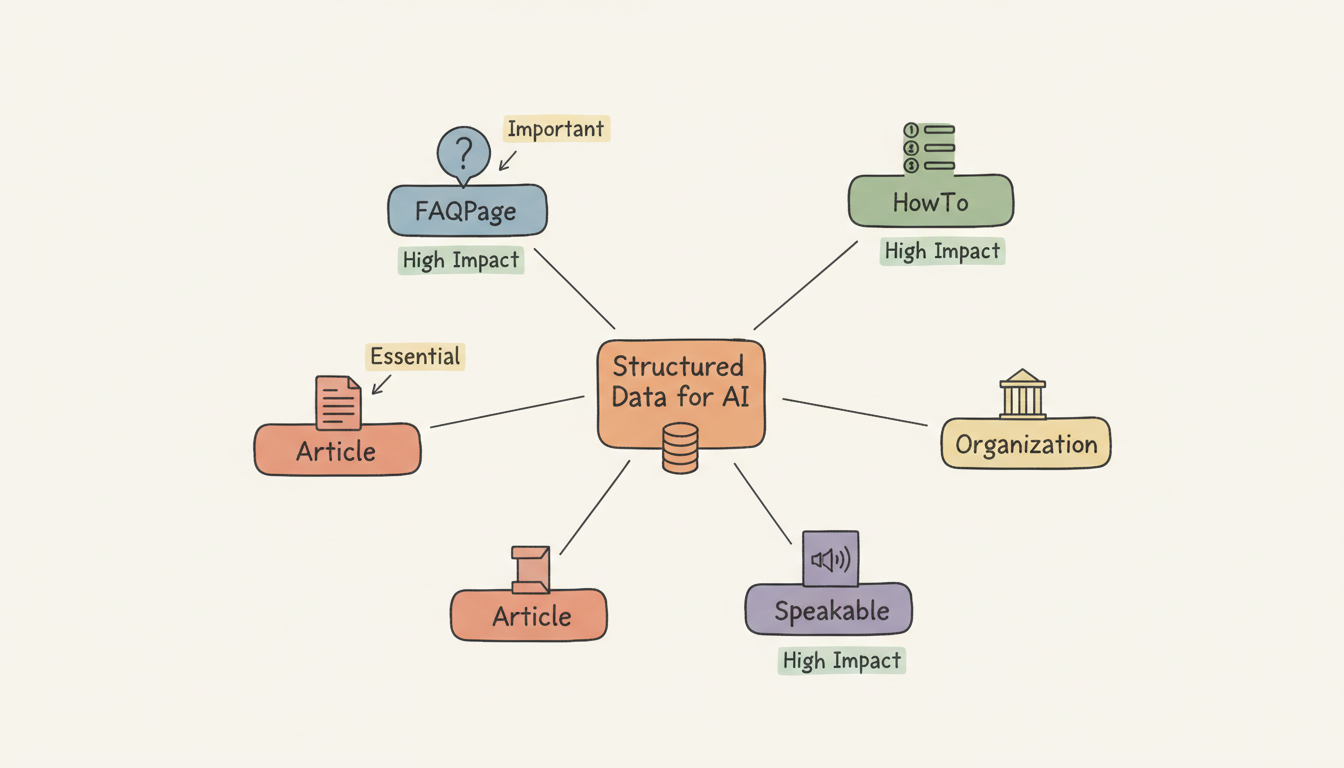
AI search platforms are shifting away from displaying isolated web pages and toward generating responses built from multiple sources.
This transition changes what optimization means. Instead of competing only for rankings, websites increasingly compete to become understandable and retrievable.
Schema markup supports this shift by creating structured relationships between entities and information.
Rather than presenting content as disconnected text, schema transforms pages into organized data that machines can interpret more efficiently. This creates several strategic advantages.
1. Schema Connects Content to Larger Knowledge Systems
One of the most important ways schema markup fits into AI search is through entity recognition.
Modern search platforms rely heavily on knowledge systems that organize information into entities and relationships.
An entity may represent a person, organization, location, product, service, or concept.
Schema helps websites communicate these entities more clearly.
For example, instead of simply mentioning a company name across multiple pages, structured data consistently identifies that organization as the same entity throughout the website.
Over time, this creates stronger identity signals. For AI systems attempting to summarize information or establish authority, these entity relationships become increasingly valuable.
Rather than treating every page independently, structured data allows websites to behave more like connected information ecosystems.
2. Schema Reduces Ambiguity and Improves Interpretation
AI models are designed to identify patterns, but ambiguity remains one of their biggest challenges.
Numbers, names, dates, and attributes can have multiple meanings depending on context.
Schema reduces this ambiguity.
For example, structured data can specify whether a numerical value represents:
- a product price
- a publication date
- a rating score
- a phone number.
- a service fee.
Without a schema, AI systems may need to infer those meanings through surrounding content. With a schema, websites provide direct interpretation signals.
This improves extraction quality and allows AI systems to spend more effort understanding meaning instead of identifying structure.
3. Schema Establishes Relationships Across Content
One of the most overlooked benefits of schema is relationship building.
Structured data does more than identify entities; it explains how those entities connect.
For example:
- An organization publishes an article.
- A person authors the article.
- The article discusses a product.
- The product belongs to the organization.
- These relationships create a connected information architecture.
Over time, this structure begins to resemble a knowledge graph that supports stronger contextual understanding.
For AI search, this matters because AI-generated answers increasingly depend on understanding relationships rather than retrieving isolated facts.
4. Schema Functions as Direct Communication for AI Systems
Traditional SEO often relies on indirect signals.
- Backlinks suggest authority.
- Keywords suggest relevance.
- Engagement metrics suggest usefulness.
- Schema works differently.
- Structured data communicates directly.
Instead of hoping AI interprets content correctly, schema provides explicit definitions.
It identifies what content represents, who owns it, and how information should be interpreted.
This direct communication model aligns naturally with AI systems that prioritize extraction, synthesis, and entity recognition.
Why the Schema Conversation Matters for Marketing Leaders
For marketing teams and decision-makers, schema implementation is not simply a technical discussion; it is a resource allocation decision. Every optimization effort competes for development time, content investment, and measurable business outcomes.
The growing importance of AI search makes schema increasingly relevant because visibility is becoming more complex. Organizations now compete across multiple AI environments.
These include AI-powered search summaries, conversational assistants, retrieval-based systems, and generative interfaces. Each platform may process structured data differently.
This uncertainty creates an important question:
Should businesses invest in schema now? The answer increasingly depends on strategic readiness rather than guaranteed outcomes.
Even where direct influence on AI visibility remains uncertain, schema strengthens overall discoverability by improving entity clarity, content organization, and machine interpretation.
Those benefits extend beyond AI alone.
How Schema Differs from Traditional SEO Signals
Traditional SEO and schema markup serve different purposes. Traditional SEO signals attempt to prove content value. Backlinks indicate authority.
Keyword optimization suggests relevance. Domain reputation builds trust. These signals help determine which content deserves visibility. Schema focuses on interpretation. Rather than showing why content matters, structured data explains what content means.
This distinction becomes increasingly important in AI search. AI systems do not simply rank pages. They interpret information, combine sources, and generate responses.
Structured data helps reduce friction during this process. Schema does not replace SEO foundations.
Instead, it strengthens them by making information easier to understand and extract.
Questions Businesses Should Ask Before Investing in Schema
As organizations evaluate how schema markup fits into AI search, several strategic questions become important.
Businesses should consider whether customers increasingly rely on AI systems to discover information.
They should assess whether competitors already use structured data and whether visibility depends on appearing within synthesized responses.
Organizations should also evaluate whether they can maintain the schema consistently across content updates and website growth.
Measurement matters as well. Implementation alone is not enough.
Businesses should track whether structured data influences discoverability, search performance, and content interpretation over time.
Is Schema Markup Worth the Investment for AI Search?
Current evidence suggests that schema should be treated as infrastructure rather than a guaranteed growth tactic.
AI systems vary significantly in how they crawl, preserve, and process structured data.
Some platforms have indicated that structured information supports interpretation.
Others have not disclosed implementation details. This means expectations should remain realistic.
Schema is unlikely to guarantee citations or immediate visibility gains.
However, it creates long-term advantages by improving clarity and reducing uncertainty.
For e-commerce websites, structured product information can improve the interpretation of pricing, availability, and product details.
For B2B companies, schema can reinforce expertise and explain service relationships.
For publishers, schema strengthens authorship and topical organization.
Ultimately, schema markup fits into AI search because it makes information easier for machines to trust, connect, and understand.
Related Searches: