How the Yieldberg AI Tool Fixes AI Search Ranking for Businesses: Growth Metric For Startups
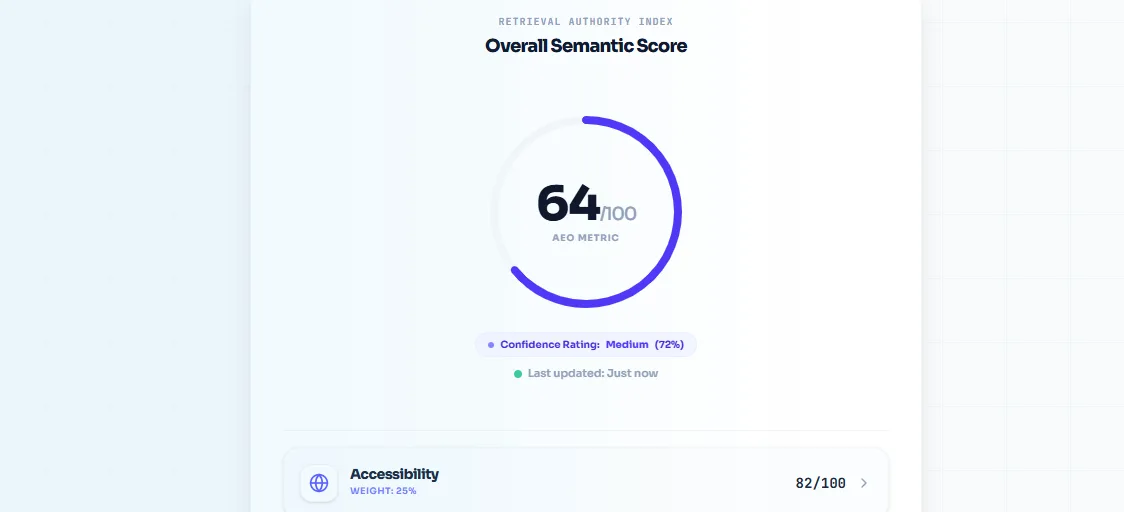
Every serious business owner tracks the metrics that matter. Revenue. Conversion rate. Cost per acquisition. Return on ad spend.

These numbers live on dashboards, get reviewed in weekly meetings, and drive every meaningful marketing decision. They exist because what gets measured gets managed, and what gets managed improves.
So here's an uncomfortable question: Are you tracking your AI search ranking for businesses in your category?
If the answer is no, and for the vast majority of businesses, it is, you're flying blind on one of the fastest-growing discovery channels your customers are using right now.
The Yieldberg AI Tool, built by the team at Yieldberg Studios, was created specifically to fix that. It's the first step toward treating AI search ranking the way every serious business already treats every other growth metric: as something measurable, improvable, and worth fighting for.
The Metric Your Competitors Are Ignoring
Here's the reality of where we are in 2025. Millions of people are using generative AI tools, ChatGPT, Perplexity, Google's AI Overviews, Microsoft Copilot, as their primary research tool before making buying decisions.
They're not typing queries into Google and scrolling through ten blue links. They're asking a question and reading a synthesized, confident answer that the AI has assembled from across the web.
That answer mentions specific businesses, specific services, and specific solutions. Someone asking "Which marketing studio specializes in AI search optimization?" is going to get a handful of names in response.
Someone asking "What tools help me track my brand in AI-generated search?" is going to get a set of recommendations. Someone asking "Who are the best GEO consultants for small businesses?" is going to get a curated shortlist.
The businesses named in those answers are getting discovered. The ones left out are not.
AI search ranking for businesses describes exactly this dynamic: how often, how prominently, and how accurately a business appears in the AI-generated answers that are shaping customer awareness in its category.
It is, without question, a growth metric. And it is, equally without question, one that almost no business is currently measuring or managing in any systematic way. That's the gap the Yieldberg AI Tool closes.
Why Most Businesses Don't Know Their AI Search Ranking
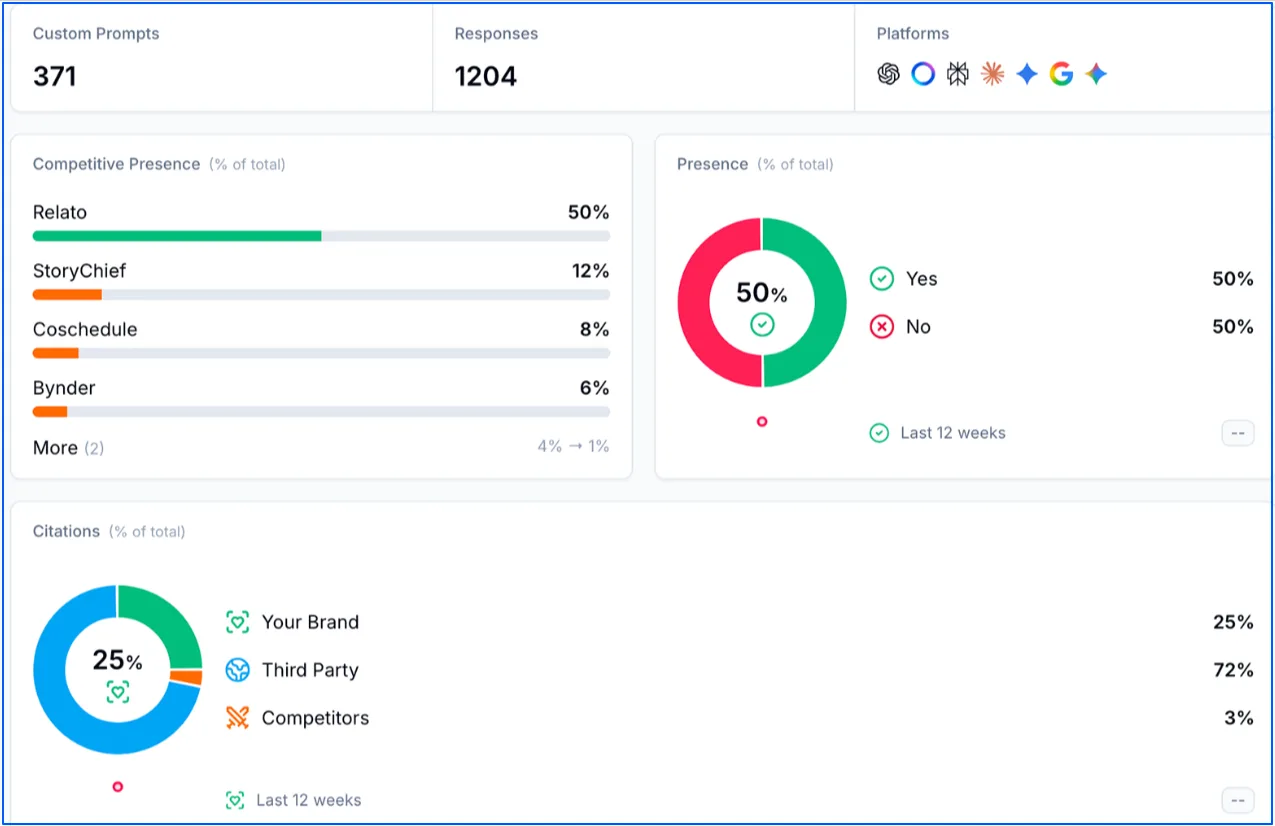
The reason most business owners aren't tracking their AI search ranking isn't a lack of awareness; it's a lack of infrastructure.
Unlike traditional search rankings, which are easy to check with any number of established tools, AI search ranking for businesses has been effectively invisible.
There's been no dashboard. No weekly report. No automated alert when a competitor suddenly starts dominating AI answers in your category.
To get even a rough sense of your AI search ranking, you'd have to manually query multiple AI platforms, vary the phrasing across dozens of relevant questions, document which brands appeared in the results, and repeat that process regularly enough to detect trends.
For a business owner managing everything else, that's not a realistic workflow. It's a research project, not a business process.
This invisibility has meant that AI search ranking has evolved from a fringe concern into a significant competitive dynamic, almost entirely under the radar for most businesses.
While the conversation around AI in marketing has focused heavily on using AI as a production tool, writing content faster, generating ad copy, and automating responses, the more consequential question of how AI systems represent your business to potential customers has gone largely unanswered. The Yieldberg AI Tool exists to answer it.
What the Yieldberg AI Tool Actually Measures
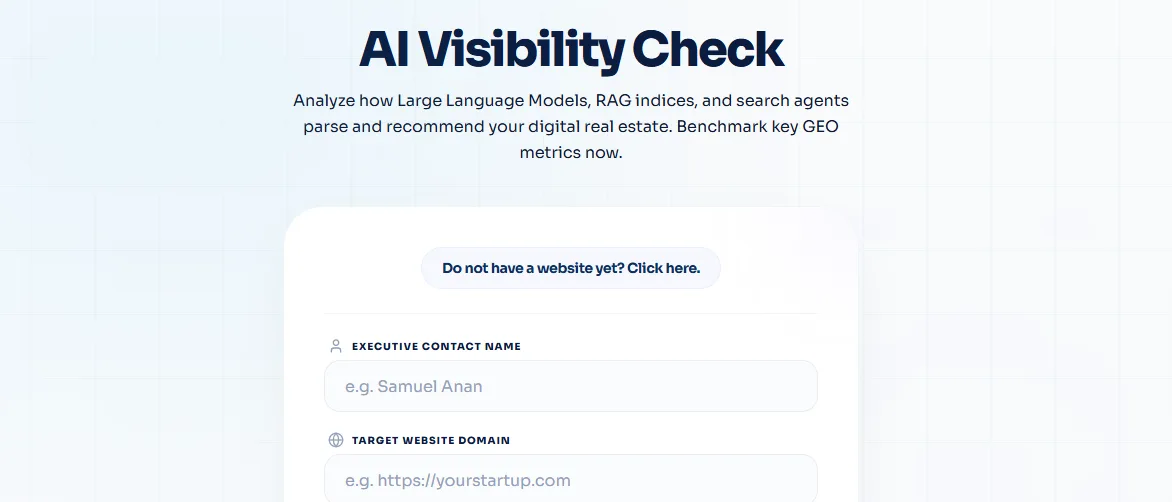
The Yieldberg AI Tool, developed by Yieldberg Studios under the leadership of certified GEO strategist Samuel Anan, takes the guesswork out of AI search ranking for businesses by building a systematic, repeatable measurement process into a single platform.
Here's what it measures and why each metric matters.
1. Citation Frequency
The most foundational measure of AI search ranking for businesses is citation frequency, how often your business is referenced in AI-generated answers to questions relevant to your industry, services, or products.
The Yieldberg AI Tool tracks this across multiple platforms simultaneously, so you're not working from a single snapshot but from a cross-platform picture of your overall AI visibility.
Low citation frequency is the clearest possible signal that your business has an AI search ranking problem. High citation frequency is the clearest possible signal that your AI visibility strategy is working.
Everything in between is data that helps you understand how much ground you have to make up and where to focus first.
2. Representation Accuracy
Citation frequency tells you whether your business is showing up. Representation accuracy tells you what AI systems are saying when they mention you. This distinction matters more than most businesses realize, because an inaccurate AI citation can be as damaging as no citation at all.
Imagine a potential customer asking an AI tool about your services and receiving an answer that describes your business using outdated information, a service you no longer offer, a pricing structure that's changed, or a market position you've moved away from.
That answer shapes the customer's perception before they ever visit your website, and if it's wrong, you're starting the relationship with a misimpression you may never get the chance to correct.
The Yieldberg AI Tool surfaces these inaccuracies specifically, flagging where AI systems are describing your business incorrectly and providing clear guidance on what changes would correct the record across platforms.
3. Competitive Benchmarking
AI search ranking for businesses doesn't exist in a vacuum. Your AI visibility position is always relative to your competitors', and in a synthesized AI answer, there are usually only a handful of brands mentioned.
The Yieldberg AI Tool benchmarks your citation frequency, accuracy, and prominence against the specific competitors you care about most.
This competitive layer transforms AI search ranking from an abstract metric into an actionable competitive intelligence tool.
When the tool shows a competitor consistently appearing in AI answers where you don't, that's a specific, fixable problem, and the tool provides enough context to understand why it's happening and what a realistic path to closing the gap looks like.
4. Gap Analysis
Beyond tracking current performance, the Yieldberg AI Tool identifies where the specific opportunities for improvement are.
It maps the queries and topic areas where your business is underrepresented or absent, ranks them by potential impact, and connects them to your existing content assets to show where you're missing coverage entirely versus where existing content simply needs to be strengthened.
This gap analysis turns the question of "how do I improve my AI search ranking?" from a daunting, open-ended challenge into a prioritized task list, one that can be handed directly to a content team, an agency, or the Yieldberg Studios team for execution.
The Connection Between AI Search Ranking and Business Growth

It's worth being direct about why AI search ranking for businesses is a growth metric and not just a vanity metric. The link between AI visibility and actual business outcomes is real and increasingly measurable.
Customer discovery is moving into AI-mediated channels faster than most businesses are tracking.
When a prospective customer asks an AI tool to recommend a service, evaluate options, or compare solutions, and your business appears prominently, accurately, and repeatedly in those answers, you earn awareness and credibility at the very first moment of the research journey, before the customer has visited any website or engaged with any content. That's top-of-funnel presence at a scale that would be expensive and difficult to replicate through paid channels.
Conversely, when a competitor appears in those answers, and you don't, the customer builds familiarity with that competitor through the AI's recommendation before you've had any chance to make an impression.
That initial familiarity is a real advantage; people tend to seek out brands they've already encountered in trusted contexts, and an AI recommendation functions as a trusted context for a growing number of users.
AI search ranking isn't the only growth metric a business needs to manage. But it's increasingly one that underlies all the others, because the businesses that are most visible in AI search are building top-of-funnel awareness that flows downstream into website traffic, lead generation, and sales conversations.
How to Use the Yieldberg AI Tool as Part of a Broader Strategy
The Yieldberg AI Tool is designed to function both as a standalone measurement platform and as the diagnostic foundation for a broader AI search ranking strategy with Yieldberg Studios.
For businesses using it as a standalone tool, the workflow is straightforward. Run the initial audit to establish a baseline across citation frequency, representation accuracy, and competitive benchmarking.
Review the gap analysis to identify the highest-impact opportunities. Implement the recommended content and structural changes, either in-house or with a content partner, and use the tool's ongoing monitoring to track improvement over time.
For businesses working directly with Yieldberg Studios, the tool feeds into a more comprehensive strategy: the audit results inform the agency's content recommendations, technical optimizations, and authority-building plan, creating a feedback loop where measurement and execution are integrated rather than separate.
Every strategy recommendation is tied back to specific data from the tool, and every subsequent monitoring cycle shows how the strategy is moving the needle on actual AI search ranking metrics.
Either way, the underlying principle is the same: you can't improve what you can't measure.
The Yieldberg AI Tool makes AI search ranking for businesses measurable for the first time, which is the necessary first step toward making it improvable.
The Right Time to Start Is Now
There's a predictable lifecycle to every new marketing discipline. First, a small group of early adopters builds expertise and gains a competitive advantage.
Then the broader market catches on, competition intensifies, and the advantage narrows. Eventually, the discipline becomes table stakes, something every serious business does, and the only differentiation left is in execution quality.
AI search ranking for businesses is in the early-adopter phase right now. The businesses investing in it today are building AI visibility positions that will compound over time and become significantly harder to displace as the broader market catches up.
The ones waiting are likely to find, in twelve or eighteen months, that they're chasing a gap that has grown considerably larger than it needed to be.
The Yieldberg AI Tool makes starting easy. It doesn't require technical expertise, a dedicated data team, or a major budget commitment to run the initial audit and get a clear picture of where your business stands. It requires the decision to look, and then the willingness to act on what you find.
In conclusion, AI search ranking for businesses is no longer an emerging concern. It is an active, competitive landscape, playing out right now in the AI tools your potential customers are already using daily.
The Yieldberg AI Tool gives you the visibility, the data, and the direction to compete in that landscape rather than be invisible to it.
Related Searches:
- How the Yieldberg AI Visibility Tool Is Changing the Game
- AI Search Visibility for Brands
- Introducing the Yieldberg AI Visibility Tool