Retrieval Augmented Generation Marketing: RAG
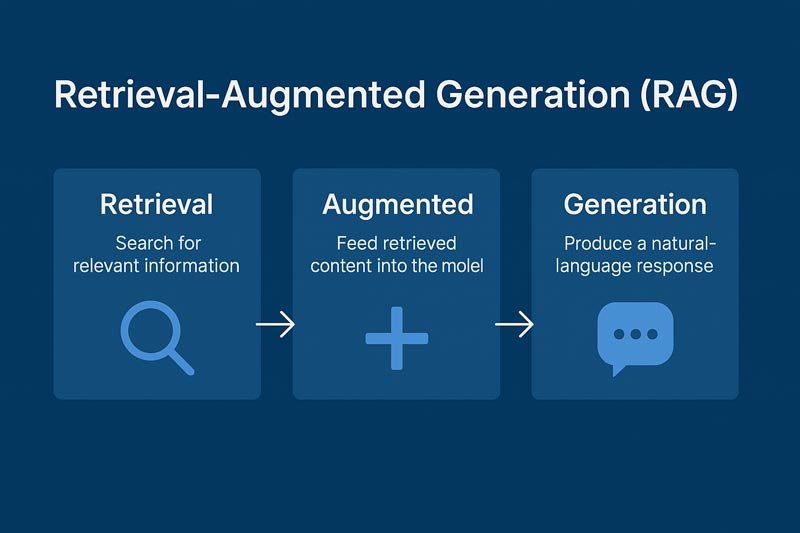
Retrieval-augmented generation (RAG) is revolutionizing the field of marketing by enhancing AI-driven content generation with real-time, external data.

Think of a marketing team trying to personalize campaigns using a vast library of customer data, case studies, and market reports.
With RAG, these teams can pull precise insights from their databases, allowing them to generate highly tailored, data-driven marketing messages.
Powered by AI and large language models (LLMs), RAG takes pre-trained models and enriches them with current, external data from sources like customer databases, marketing analytics, and industry reports.
This ensures that AI-generated content is not only accurate but also enriched with timely, contextual insights, which traditional models alone cannot provide.
What is RAG Retrieval Augmented Generation Marketing?
RAG retrieval augmented generation marketing is the use of Retrieval-Augmented Generation (RAG) systems to improve how marketing teams access data, generate insights, and create AI-driven content.
In simple terms, it is a system that allows large language models (LLMs) to pull real-time, relevant marketing data from trusted sources before generating responses.
Instead of relying only on pre-trained knowledge, RAG-enhanced marketing systems retrieve fresh information from sources like CRM platforms, analytics dashboards, customer feedback, and market research databases.
This allows marketing teams to produce more accurate, context-aware, and up-to-date outputs. In a business environment, RAG retrieval augmented generation marketing improves campaign strategy, customer targeting, content personalization, and performance analysis.
It helps teams make faster, data-backed marketing decisions using internal and external knowledge sources.
How Does RAG Work in Business AI Marketing Systems?

For RAG retrieval augmented generation marketing to function effectively, it must connect to external marketing data sources such as customer databases, SEO tools, social media analytics, and internal documentation.
The workflow follows three core steps:
1. Marketing data retrieval
When a marketer asks a question, the system identifies what data is needed and pulls relevant information from connected sources.
For example, it may retrieve campaign performance metrics, audience behavior data, or keyword rankings.
2. Augmentation
The retrieved marketing data is combined with the LLM prompt. This gives the AI system real-world context.
For instance, if a marketer asks, “Which campaign generated the highest ROI last quarter?”, the system pulls campaign reports and integrates them into the prompt.
3. Response Generation
The AI model then generates a detailed, context-aware answer using both its training data and the retrieved marketing insights. The result is a more accurate and actionable marketing recommendation.
This process allows marketing teams to move from guesswork to real-time, evidence-based decision-making. RAG essentially bridges the gap between raw business data and intelligent marketing insights.
Key Applications of RAG Retrieval Augmented Generation Marketing
RAG retrieval augmented generation marketing is transforming how businesses operate across departments by enabling AI systems to access real-time, verified data before generating responses.
This makes outputs more accurate, context-aware, and useful for decision-making. Below are key real-world applications of RAG in business environments.
1. Customer Support
Customer support teams can now rely on AI systems powered by RAG retrieval augmented generation marketing to deliver fast, accurate, and personalized responses.
In industries like telecommunications, RAG-powered chatbots can instantly retrieve customer billing records, service histories, and network status updates. This allows support agents or automated systems to respond to issues such as billing disputes or network failures in real time.
The result is faster resolution times, improved customer satisfaction, and more consistent support experiences across all channels.
2. Contract Analysis
RAG retrieval augmented generation marketing significantly improves how legal and compliance teams handle complex documents.
Instead of manually scanning lengthy contracts, RAG systems retrieve relevant clauses, compare terms across documents, and highlight potential risks or inconsistencies. Law firms and corporate legal departments use this to speed up contract review cycles.
This reduces human error, minimizes oversight, and ensures compliance with legal standards while allowing reviewers to focus on decision-making rather than manual search.
3. Enterprise Search
One of the biggest challenges in modern organizations is scattered data across multiple platforms. RAG retrieval augmented generation marketing solves this by powering intelligent enterprise search systems.
These systems retrieve relevant documents from databases, cloud storage, CRMs, and internal knowledge bases, then present the results in a structured and concise format.
For example, consulting teams can quickly locate research reports, case studies, or internal notes without manually searching through folders or disconnected systems.
Related Searches:
4. Business Intelligence
RAG enhances business intelligence by combining AI-generated summaries with real-time business data.
It retrieves insights from dashboards, sales reports, customer feedback, and external market trends, then generates clear and actionable summaries. Advanced systems can also analyze historical data to predict future trends.
For example, a retail business can use RAG retrieval augmented generation marketing to analyze seasonal sales patterns and recommend inventory adjustments or promotional strategies. This helps executives make proactive, data-driven decisions.
5. Financial Reporting
Finance teams use RAG systems to automate and improve the accuracy of financial reporting.
RAG models extract data from accounting platforms, invoices, transaction logs, and budgeting tools, then compile structured financial reports. This reduces manual workload and ensures higher data accuracy.
Investment firms, for instance, can use RAG to generate timely financial summaries and performance reports for stakeholders with minimal human intervention.
6. Audit Assistants
RAG retrieval augmented generation marketing also plays a major role in auditing and compliance processes.
Auditors can use RAG systems to quickly retrieve financial records, internal policies, and transaction histories, making it easier to identify anomalies or irregularities.
In large corporations, this reduces the time required for audits while improving accuracy and ensuring that no critical compliance issue is missed.
7. Sales Enablement
Sales teams benefit greatly from RAG systems by gaining instant access to relevant customer and market intelligence.
RAG retrieves data such as customer interactions, industry trends, competitor activity, and internal product information, then uses it to generate personalized sales recommendations and pitches.
This helps sales professionals better understand customer needs, tailor their messaging, and close deals faster with higher precision.
How Does Agentic RAG Enhance Business Intelligence?

Agentic RAG takes RAG retrieval augmented generation marketing a step further by adding autonomy to AI systems. Instead of only retrieving and generating text, agentic systems can also execute actions and workflows.
For example, an agentic RAG system can:
- Retrieve customer insights from databases
- Generate a performance summary
- Automatically send reports via email or API integrations
This makes it especially valuable for marketing teams that rely on real-time analytics, campaign optimization, and automated reporting.
By combining reasoning with action, agentic RAG improves efficiency and turns AI from a passive assistant into an active business tool.
What are the Common Challenges When Implementing RAG in Marketing?
While RAG retrieval augmented generation marketing offers powerful benefits, implementation comes with challenges:
1. Data privacy
Marketing systems often handle sensitive customer data. Businesses must enforce strict access controls, encryption, and compliance policies to protect information.
2. Integration complexity
RAG must connect with CRMs, analytics tools, and content databases. Poor integration can reduce performance and lead to incomplete or inaccurate outputs.
3. Scalability
As marketing data grows, systems must remain fast and responsive. Cloud infrastructure and optimized indexing are essential.
4. Cost management
RAG systems can be resource-intensive. Many businesses start small, such as using RAG for customer support or content search, before scaling.
5. Domain adaptation
Marketing language varies across industries. Without proper tuning, RAG systems may misinterpret brand tone or industry-specific terminology.