AI Ethics Courses: Best AI Ethics Courses for Upskilling in 2026
As AI technologies become increasingly embedded in everyday life, concerns surrounding fairness, privacy, transparency, accountability, and bias have moved to the forefront of public discourse.
While organizations are investing heavily in AI innovation, there is growing recognition that technological advancement without ethical oversight can create unintended consequences.
From biased algorithms and invasive data collection practices to misinformation and automated decision-making, the risks associated with poorly governed AI systems are becoming impossible to ignore.
This is why AI ethics has emerged as one of the most valuable areas of professional development in recent years.
Whether you are a software engineer building intelligent systems, a business leader implementing AI strategies, a policymaker shaping regulations, or a marketer leveraging generative AI tools, understanding the ethical dimensions of artificial intelligence is essential.
The right AI ethics course can help you navigate these challenges while equipping you with practical frameworks for responsible innovation. To help you choose the best learning path, we have compiled a list of the most valuable AI ethics courses available in 2026.
Best AI Ethics Courses for Upskilling in 2026

The courses featured in this guide cover a wide spectrum of topics, including AI governance, algorithmic fairness, responsible machine learning, regulatory compliance, data privacy, and ethical decision-making.
Whether you're seeking a beginner-friendly introduction or a university-backed professional certification, these programs offer valuable insights into the responsible development and deployment of artificial intelligence.
1. Ethics of Artificial Intelligence (Politecnico di Milano)

As artificial intelligence becomes increasingly integrated into business and society, professionals need more than technical expertise; they need a strong ethical foundation.
The Ethics of Artificial Intelligence course from Politecnico di Milano provides learners with a comprehensive introduction to the ethical dilemmas that accompany AI innovation.
The course examines how AI systems affect human rights, personal privacy, social justice, and decision-making processes. Learners are introduced to established ethical frameworks and practical approaches for evaluating the societal consequences of AI applications.
One of the course's strengths is its balance between theory and real-world relevance. Participants gain insights into how ethical principles can be translated into responsible AI practices within organizations and public institutions.
Who It's For
- AI professionals and developers.
- Technology consultants.
- Researchers and academics.
- Individuals interested in responsible AI development.
Topics Covered
- Ethical challenges in AI development.
- AI accountability and decision-making.
- Privacy and surveillance concerns.
- Human rights and artificial intelligence.
- Responsible AI governance.
Course Details
- Format: Online
- Exam Required: Yes
- Duration: Approximately 10 hours
- Instruction Style: Self-paced
- Prerequisites: None
- Cost: Free to audit; certification available for an additional fee
Why Take This Course?
This course provides a solid foundation for understanding the ethical responsibilities associated with AI development and deployment, making it an excellent starting point for professionals entering the field.
2. Ethics of AI (LSE Online)
Artificial intelligence raises questions that extend far beyond technology. Issues surrounding governance, accountability, societal impact, and public trust require careful examination from ethical, philosophical, and regulatory perspectives.
The Ethics of AI course offered by LSE Online explores these complex topics through a multidisciplinary lens. Participants engage with real-world case studies that demonstrate how AI is influencing public policy, business operations, and societal decision-making.
Rather than focusing solely on technical concepts, the course encourages critical thinking about the broader implications of AI adoption. Learners examine ethical frameworks, governance models, and policy challenges that organizations face when implementing AI systems.
Who It's For
- Policymakers.
- Senior business leaders.
- Technology strategists.
- Compliance and governance professionals.
Topics Covered
- Foundations of AI ethics.
- Ethical decision-making frameworks
- AI governance and regulation.
- Public policy implications.
- Real-world AI ethics case studies.
Course Details
- Format: Online
- Exam Required: No
- Duration: 3 Weeks
- Weekly Commitment: 6–8 Hours
- Prerequisites: None
- Cost: $652
Why Take This Course?
If you want to understand how AI intersects with law, policy, and organizational governance, this course offers valuable perspectives that go beyond purely technical discussions.
3. Ethics in the Age of Generative AI (LinkedIn Learning)

The rapid rise of generative AI platforms has transformed how individuals and organizations create content, analyze data, and automate workflows. However, these advances have also introduced new ethical questions regarding ownership, transparency, misinformation, and accountability.
Ethics in the Age of Generative AI addresses these emerging concerns by examining the societal impact of technologies such as GPT models, AI-generated imagery, and automated content systems.
Through concise yet insightful lessons, participants explore the ethical challenges associated with generative AI while learning strategies for responsible implementation within professional environments.
Because of its practical focus and accessible format, the course is particularly useful for business professionals who want a quick but meaningful introduction to AI ethics.
Who It's For
- Business executives.
- AI practitioners.
- Content creators.
- Marketing professionals.
- Digital transformation leaders.
Topics Covered
- Generative AI technologies.
- Ethical concerns surrounding AI-generated content.
- Accountability and responsibility.
- Governance frameworks.
- Emerging AI regulations.
Course Details
- Format: Online
- Exam Required: No
- Duration: Approximately 1 Hour
- Instruction Style: Self-paced
- Prerequisites: None
- Cost: Free with LinkedIn Learning access
Why Take This Course?
This course is ideal for busy professionals seeking a concise overview of the ethical implications associated with generative AI technologies.
4. AI Ethics for Beginners (Great Learning)
![Free Generative AI Course for Beginners with Certificate [2026]](https://dtmvamahs40ux.cloudfront.net/public/seo-image/seo-image-2770-free-generative-ai-course.webp)
For individuals completely new to the subject, AI Ethics for Beginners offers an accessible introduction to one of the most important conversations in modern technology.
The course breaks down complex ethical concepts into easy-to-understand lessons, helping learners understand how artificial intelligence influences society, business operations, and decision-making processes.
Without requiring any technical background, participants explore fundamental topics such as fairness, bias, accountability, privacy, and responsible AI implementation.
The course also examines how machine learning and big data contribute to ethical challenges across industries.
Its beginner-friendly structure makes it an excellent entry point for students, professionals, and curious learners alike.
Who It's For
- Beginners with no AI background.
- Students.
- Business professionals.
- Technology enthusiasts.
Topics Covered
- Introduction to AI ethics.
- Core ethical principles.
- Fairness and accountability.
- AI-related societal challenges.
- Responsible AI implementation.
Course Details
- Format: Online
- Exam Required: No
- Duration: 2.25 Hours
- Instruction Style: Self-paced
- Prerequisites: None
- Cost: Free
Why Take This Course?
If you're just starting your AI ethics journey, this course offers a simple and approachable foundation without overwhelming technical jargon.
5. Artificial Intelligence Ethics (University of Oxford)
![Oxford Artificial Intelligence Program [In-Depth Review][2026] - DigitalDefynd Education](https://digitaldefynd.com/IQ/wp-content/uploads/2025/10/Oxford-Artificial-Intelligence-Program.png)
The University of Oxford's Artificial Intelligence Ethics course is one of the most prestigious options available for professionals seeking an advanced understanding of AI governance and ethical decision-making.
The program examines how AI technologies affect individuals, organizations, and society at large. Participants explore topics such as algorithmic accountability, governance structures, privacy rights, fairness, and the social consequences of automated decision-making.
Unlike many introductory courses, Oxford's program encourages deeper reflection on the philosophical and practical dimensions of AI ethics. Learners are challenged to evaluate real-world dilemmas and consider how ethical frameworks can guide responsible technological development.
The course is particularly valuable for professionals who influence policy, strategy, or governance decisions related to artificial intelligence.
Who It's For
- Executives and decision-makers.
- Ethics professionals.
- Policymakers.
- Researchers and academics.
- Technology leaders.
Topics Covered
- AI governance and regulation.
- Ethical frameworks for AI systems.
- Data governance and privacy.
- Social impact of artificial intelligence.
- Responsible innovation strategies.
Course Details
- Format: Online
- Exam Required: No
- Duration: 5 Weeks
- Weekly Commitment: 2–4 Hours
- Prerequisites: None
Pricing
- Pre-2023 Enrolled Students (MSt Practical Ethics): £2,100
- Short Course Fee (2025–2026): £2,700
- MSt Practical Ethics Students (2025–2026): £2,195
Why Take This Course?
For professionals seeking a world-class education in AI ethics, governance, and responsible innovation, Oxford's program offers one of the most comprehensive and academically respected learning experiences available today.
6. Data and Artificial Intelligence Ethics (The University of Edinburgh)

As artificial intelligence increasingly relies on vast quantities of data, understanding the ethical implications of data collection, storage, analysis, and governance has become a critical skill for modern professionals.
The University of Edinburgh's Data and Artificial Intelligence Ethics course provides a comprehensive academic exploration of the relationship between data-driven technologies and ethical responsibility.
The program examines how AI systems influence individuals, organizations, and society while emphasizing the importance of transparency, accountability, and responsible data stewardship.
Learners gain a deeper appreciation of the ethical challenges that arise when deploying AI solutions in real-world environments, particularly in sectors such as healthcare, finance, government, and education.
What sets this course apart is its strong focus on balancing technological innovation with societal values. Participants are encouraged to critically evaluate how AI systems affect privacy rights, fairness, and public trust.
Who It's For
- Postgraduate students.
- Data scientists.
- AI professionals.
- Researchers and academics.
- Policy and governance specialists.
Topics Covered
- Data governance and responsible data practices.
- Ethical implications of AI deployment.
- Privacy, consent, and data protection.
- Algorithmic accountability.
- Transparency in automated decision-making.
Course Details
- Format: Online
- Exam Required: Yes
- Duration: 1 Year
- Prerequisites: Undergraduate Degree Required
Why Take This Course?
This course is ideal for professionals seeking a rigorous academic understanding of AI ethics and data governance. Its in-depth curriculum provides valuable insights into the ethical responsibilities associated with developing and deploying AI systems at scale.
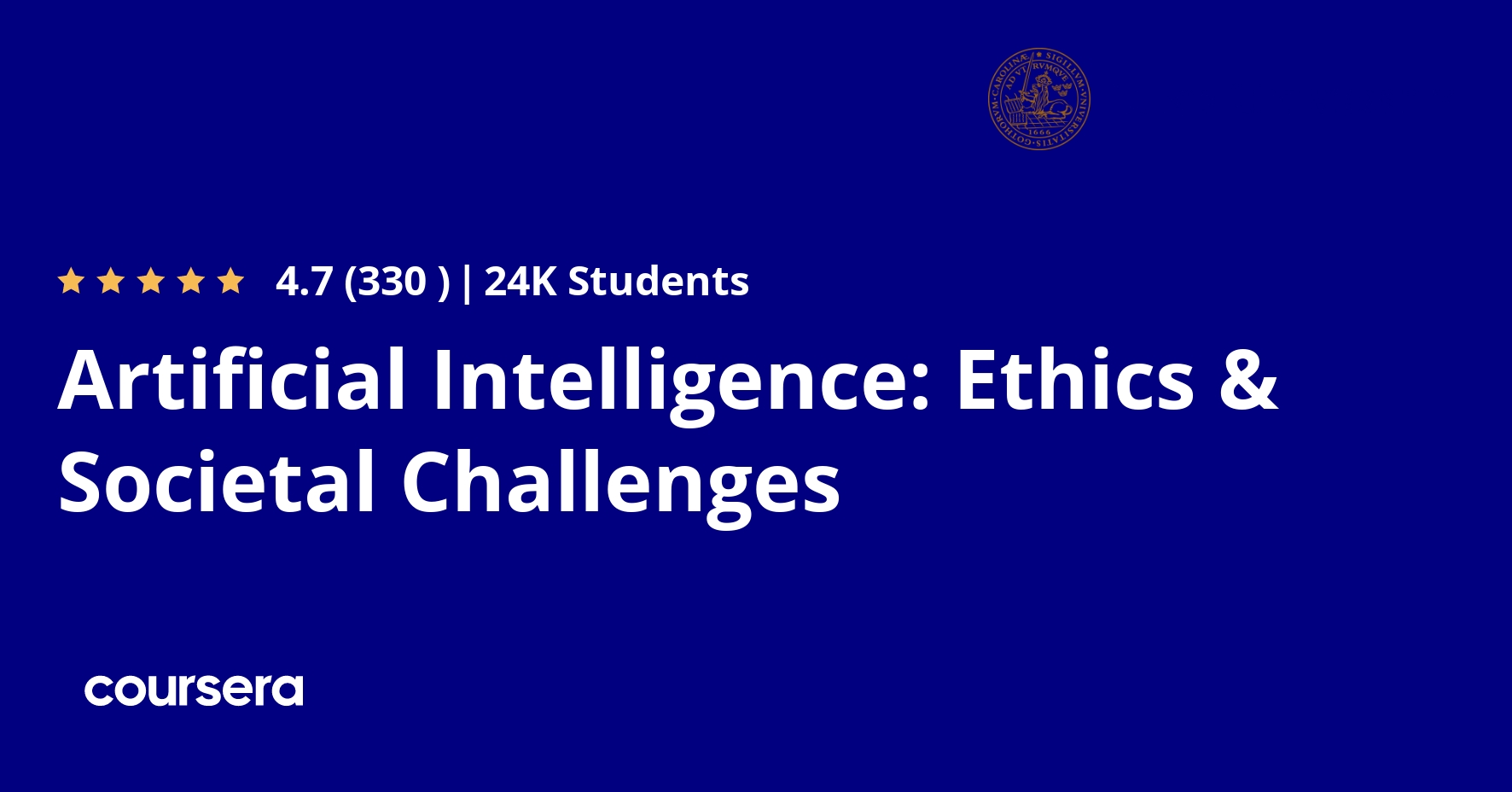
7. Artificial Intelligence: Ethics & Societal Challenges (Lund University)
Artificial intelligence is transforming industries and reshaping societies, but its rapid adoption also introduces complex ethical questions.
Lund University's Artificial Intelligence: Ethics & Societal Challenges course explores these issues through a multidisciplinary lens, helping learners understand both the opportunities and risks associated with AI technologies.
The course investigates how AI influences employment, governance, social equity, privacy, and human autonomy. Learners are encouraged to critically assess the broader consequences of AI deployment while exploring practical approaches to responsible innovation.
One of the course's greatest strengths is its accessibility. Despite covering sophisticated concepts, it remains approachable for learners from non-technical backgrounds who want to understand AI's impact on society.
Who It's For
- Students and lifelong learners.
- Business professionals.
- Policymakers.
- Technology enthusiasts.
- Anyone interested in AI's societal implications.
Topics Covered
- Ethical dilemmas surrounding AI.
- Social and economic impact of automation.
- AI governance and regulatory frameworks.
- Responsible AI design principles.
- Future challenges in artificial intelligence.
Course Details
- Format: Online
- Exam Required: Yes
- Duration: Approximately 13 Hours
- Learning Style: Self-Paced
- Prerequisites: None
Pricing
- Free to Audit
- Optional Fee for Verified Certificate
Why Take This Course?
If you want to understand how AI is influencing society beyond technical applications, this course provides an excellent foundation. It combines ethical theory with practical discussions about AI's role in shaping the future.
8. AI, Empathy & Ethics (University of California, Santa Cruz)

Can artificial intelligence understand empathy? Should machines be designed to replicate human emotional intelligence? These are some of the fascinating questions explored in AI, Empathy & Ethics from the University of California, Santa Cruz.
Unlike many AI ethics courses that focus primarily on regulation and governance, this program explores the human side of artificial intelligence. It examines how AI technologies affect interpersonal relationships, emotional well-being, decision-making, and human interaction.
Participants explore the ethical responsibilities associated with creating AI systems capable of influencing emotions, behavior, and social experiences. The course encourages thoughtful reflection on the boundaries between human values and machine intelligence.
Who It's For
- Human-centered AI practitioners.
- UX designers.
- Product managers.
- AI developers.
- Professionals interested in ethical technology design.
Topics Covered
- AI and emotional intelligence.
- Human-centered technology design.
- Ethical considerations in empathetic AI.
- Decision-making and behavioral influence.
- Future implications of emotionally aware systems.
Course Details
- Format: Online
- Exam Required: No
- Duration: Approximately 4 Hours
- Learning Style: Self-Paced
- Prerequisites: None
Pricing
- Free to Audit
- Optional Paid Certificate Available
Why Take This Course?
This course offers a unique perspective rarely covered in traditional AI ethics programs. It is particularly valuable for professionals designing AI systems that directly interact with users and influence human experiences.
9. Certificate in Ethical Artificial Intelligence (CISI)

For professionals working in highly regulated industries, ethical AI knowledge is rapidly becoming a sought-after qualification. The Certificate in Ethical Artificial Intelligence from CISI (Chartered Institute for Securities & Investment) focuses on the practical challenges organizations face when implementing AI responsibly.
The program emphasizes governance, risk management, compliance requirements, and ethical decision-making. Participants gain a solid understanding of how regulatory frameworks are evolving and what businesses must do to ensure AI systems remain trustworthy and compliant.
Because of its strong compliance focus, the certification is particularly relevant for professionals operating in financial services, banking, insurance, and corporate governance roles.
Who It's For
- Finance professionals.
- Compliance officers.
- Risk managers.
- Governance specialists.
- Technology leaders.
Topics Covered
- AI governance and oversight.
- Ethical risks in AI systems.
- Regulatory compliance.
- Responsible AI implementation.
- AI applications in financial services.
Course Details
- Format: Online
- Exam Required: Yes
- Duration: Approximately 12 Hours
- Learning Style: Self-Paced
- Prerequisites: None
Pricing
- CISI Members: £60
- Non-Members: £150
Why Take This Course?
If your role involves regulatory compliance, risk management, or governance, this certification provides practical knowledge that can be immediately applied within professional environments.
10. AI Ethics (DataCamp)

Artificial intelligence is becoming an essential skill for data professionals, but understanding its ethical implications is equally important.
DataCamp's AI Ethics course offers a concise yet impactful introduction to the ethical challenges associated with AI development and deployment.
The course uses real-world examples and practical case studies to illustrate issues such as algorithmic bias, transparency, accountability, and fairness. Rather than focusing exclusively on theory, learners gain actionable insights into how ethical considerations influence data science and machine learning projects.
Its short duration makes it an excellent option for busy professionals who want to quickly strengthen their understanding of responsible AI practices.
Who It's For
- Data analysts.
- Data scientists.
- Machine learning practitioners.
- Business intelligence professionals.
- AI enthusiasts.
Topics Covered
- Ethical risks in AI.
- Algorithmic bias and discrimination.
- Transparency and explainability.
- Accountability in AI systems.
- Practical AI ethics case studies.
Course Details
- Format: Online
- Exam Required: No
- Duration: 1 Hour
- Instruction Time: 1 Hour
- Prerequisites: None
Pricing
- Free
Why Take This Course?
This course delivers a practical introduction to AI ethics in a compact format, making it perfect for professionals who want immediate, actionable knowledge without committing to a lengthy program.
11. Impact, Ethics, and Issues with Generative AI (IBM)
Generative AI has become one of the most disruptive technological innovations of the decade. From content creation and software development to customer service and business automation, its influence continues to expand across industries.
IBM's Impact, Ethics, and Issues with Generative AI course examines both the opportunities and risks associated with these powerful technologies. Participants explore topics such as misinformation, intellectual property concerns, bias, accountability, and the societal consequences of large language models.
The course combines theoretical discussions with real-world examples, helping learners understand how organizations can implement generative AI responsibly while minimizing unintended consequences.
Who It's For
- AI professionals.
- Business leaders.
- Technology consultants.
- Digital transformation specialists.
- Anyone working with generative AI.
Topics Covered
- Generative AI fundamentals.
- Ethical challenges and societal impact.
- AI bias and misinformation.
- Responsible AI deployment.
- Emerging regulations and governance.
Course Details
- Format: Online
- Exam Required: No
- Duration: 3 Weeks
- Weekly Commitment: 1–3 Hours
- Prerequisites: None
Pricing
- Free to Audit
- Certificate Option: $49
Why Take This Course?
For professionals seeking a deeper understanding of the ethical implications of ChatGPT, AI image generators, and other generative technologies, this IBM course offers practical insights and industry relevance.
12. Ethics of AI: Safeguarding Humanity (Massachusetts Institute of Technology)

MIT's Ethics of AI: Safeguarding Humanity is one of the most advanced and prestigious AI ethics programs available today. The course investigates how artificial intelligence can be developed in ways that align with human values while minimizing risks to individuals and society.
Participants explore topics such as human rights, responsible innovation, governance, ethical system design, and long-term AI safety. The program encourages strategic thinking about the future of AI and the responsibilities that accompany technological leadership.
Who It's For
- Engineers.
- Developers.
- Executives.
- Policymakers.
- Technology strategists.
Topics Covered
- Human-centered AI development.
- AI ethics and governance.
- Human rights considerations.
- Risk mitigation strategies.
- Long-term societal impact.
Course Details
- Format: Online
- Exam Required: No
- Duration: 3 Days
- Prerequisites: None
Pricing
- $3,200
Why Take This Course?
Professionals seeking an executive-level understanding of AI ethics and governance will find immense value in MIT's world-renowned approach to responsible innovation.
13. Ethics in AI Design (Delft University of Technology)

Ethics should not be added to AI systems after development; it should be embedded into the design process from the beginning. Delft University of Technology's Ethics in AI Design course focuses on precisely that challenge.
The program teaches participants how to incorporate ethical principles into AI products, algorithms, and decision-making systems. Through practical frameworks and real-world examples, learners discover how to design AI technologies that are fair, transparent, accountable, and aligned with societal expectations.
Who It's For
- AI designers.
- Software developers.
- Product managers.
- UX professionals.
- Technology innovators.
Topics Covered
- Ethical AI design frameworks.
- Human-centered artificial intelligence.
- Fairness and bias mitigation.
- Transparency and accountability.
- Responsible innovation methodologies.
Course Details
- Format: Online
- Exam Required: Yes
- Duration: 7 Weeks
- Weekly Commitment: 2–4 Hours
- Prerequisites: None
Pricing
- Free to Audit
- Verified Certificate: $149
Why Take This Course?
This course is ideal for professionals directly involved in building AI products and services. It provides practical guidance on creating systems that are not only innovative but also ethically responsible and socially beneficial.
What Should You Study to Become an AI Ethicist?
Becoming an AI ethicist typically requires a blend of technical knowledge, ethics, law, and social sciences. Since AI ethics is interdisciplinary, there is no single educational path.
Subjects that are particularly valuable include:
- Artificial Intelligence and Machine Learning: Understanding how AI systems are built and trained.
- Computer Science: Learning algorithms, data structures, and software development.
- Philosophy and Ethics: Studying moral reasoning, fairness, accountability, and ethical frameworks.
- Data Science: Understanding data collection, bias, and analytics.
- Law and Public Policy: Learning about privacy regulations, AI governance, and compliance.
- Sociology and Psychology: Understanding how technology affects individuals and society.
Many AI ethicists begin with degrees in Computer Science, Philosophy, Law, Public Policy, Data Science, or Cognitive Science before specializing in AI ethics through certifications, postgraduate programs, or professional training.
Which AI Has the Best Ethics?
There is no universally accepted "most ethical AI." Ethical performance depends on how an AI system is designed, trained, governed, and monitored.
However, several organizations are recognized for investing heavily in responsible AI practices:
- OpenAI: Focuses on AI safety, alignment, transparency, and responsible deployment.
- IBM: Known for its AI governance frameworks and ethical AI initiatives.
- Microsoft: Has established Responsible AI Standards and governance policies.
- Google DeepMind: Invests significantly in AI safety and ethics research.
It's important to note that no AI system is completely free from bias or ethical challenges. The most responsible organizations continuously audit, test, and improve their systems to reduce risks and increase fairness.
What Degree Is Best for Ethics in AI?
The best degree depends on your career goals, but the most relevant options include:
For Technical AI Ethics Roles
- Bachelor's or Master's in Computer Science
- Artificial Intelligence
- Data Science
- Machine Learning
Related Searches:
AI Ethics: in Digital Marketing