7 AI Visibility Tools to Track Your Brand Across LLMs
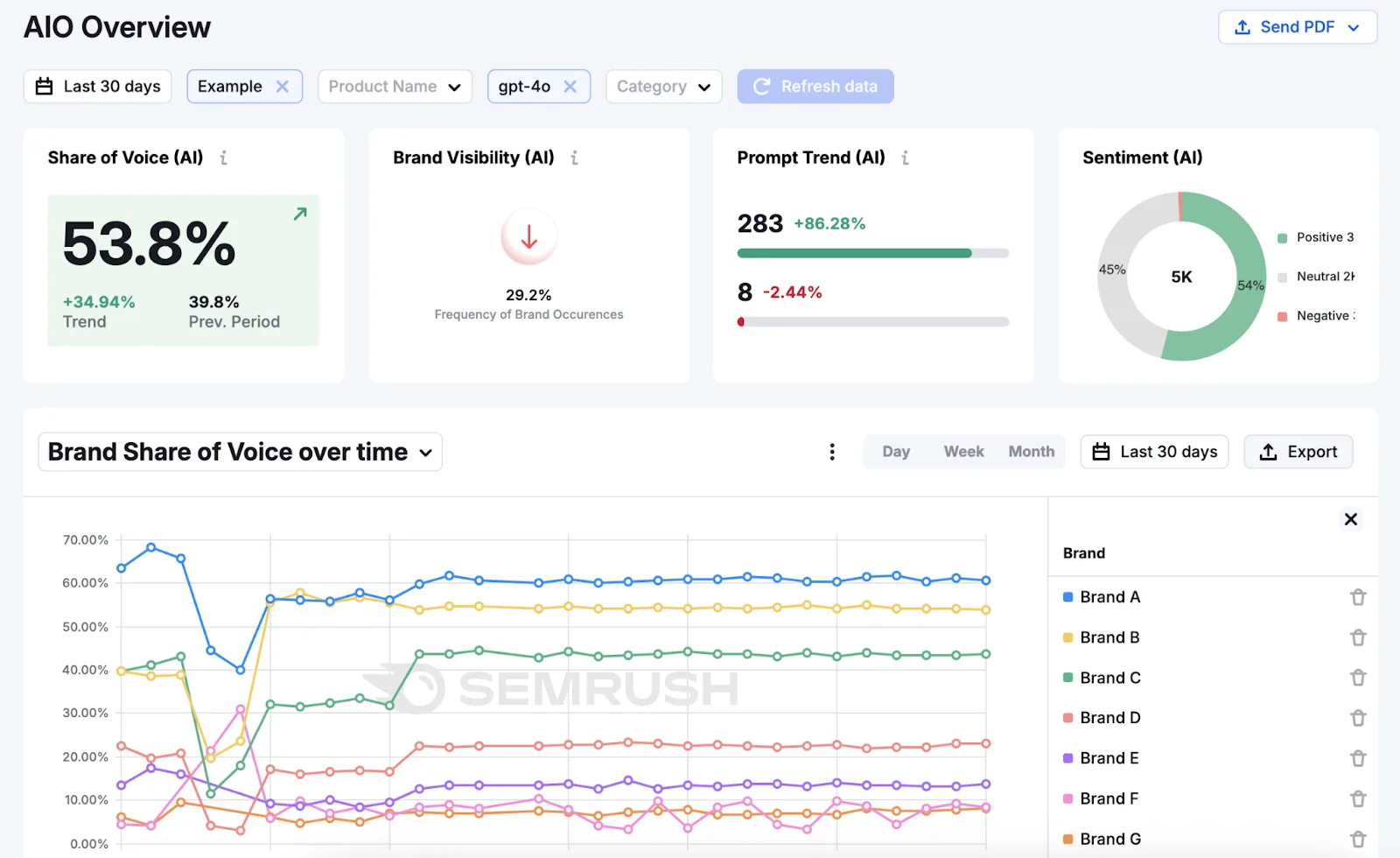
LLMs like ChatGPT and Gemini are quickly becoming the first place people turn when researching brands, products, and services. The challenge is that most companies still lack real visibility into how they appear in these answers. That blind spot is growing. AI responses shape perception long before someone ever reaches your website.
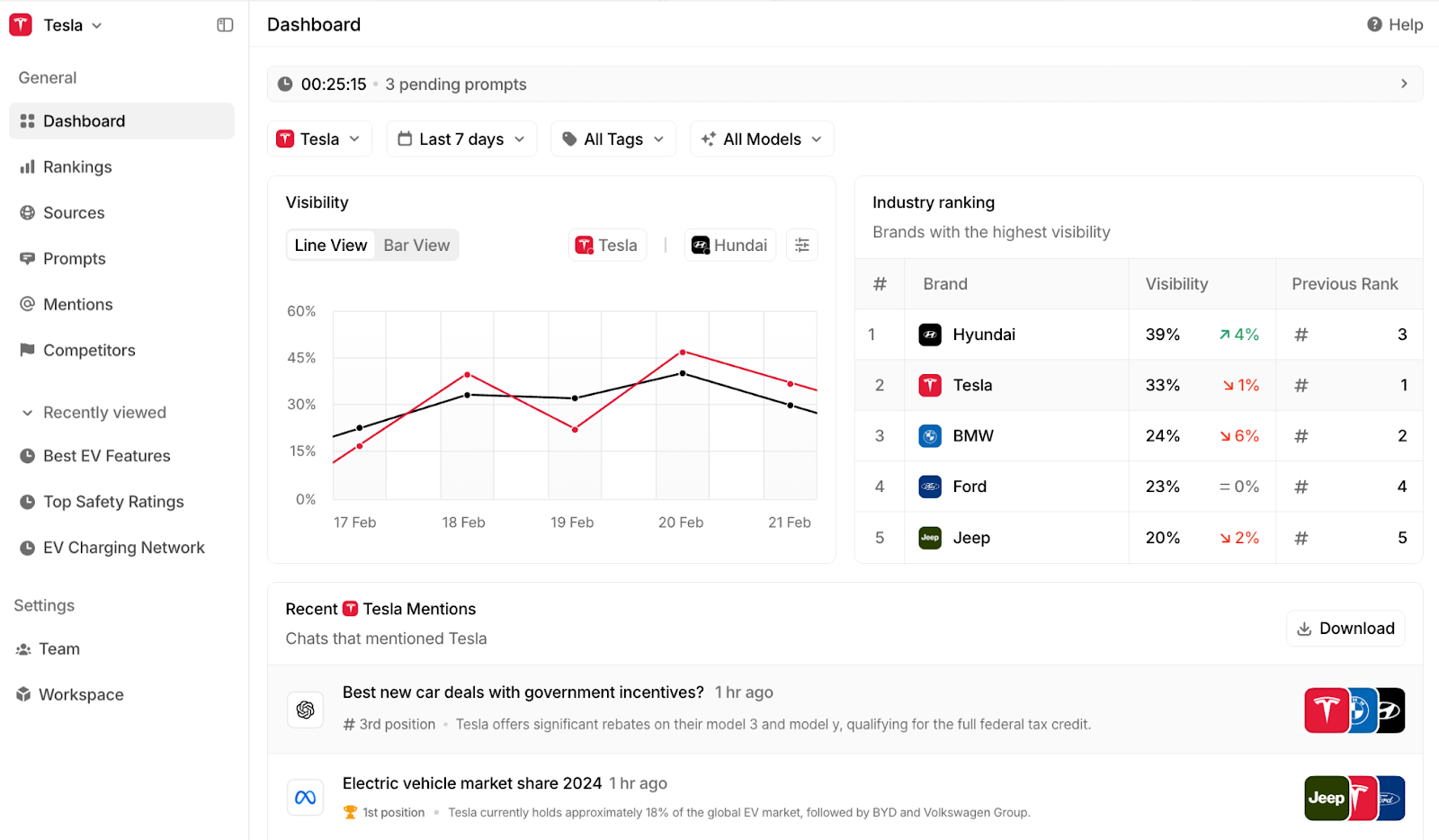
The early data make this clear. This is why AI visibility matters. It is no longer about traffic alone. It is about presence, accuracy, and how your brand is positioned inside the systems people trust for answers.
To stay ahead, you need the right tools. After testing more than a dozen LLM tracking platforms, from enterprise solutions to newer entrants, not all are fully mature, and it is hard to know which will survive in the long term.
But each one highlights a different direction the market is moving.
Here are the seven that stand out right now.
What to Look For in an LLM Tracking Tool

There are free AI visibility checkers out there, which are great for an introductory look at how your brand is performing in LLM answers. But if you need more data and context, you will likely need to go the paid route.
A lot of paid LLM tracking tools look impressive at first glance. Once you dig in, many fall short. The most common issues are fragile scraping setups, limited coverage, or dashboards that look polished but fail to surface the insights that actually matter.
Here is what to consider:
1. Real scale: Because AI responses vary significantly run-to-run, you need a large enough prompt sample to get a statistically meaningful read on your visibility. Thousands of prompts run from the UI, not just the APIs. Otherwise, you miss key results like tables and maps.
2. Multi-engine coverage: ChatGPT is table stakes. Top tools also track Google AI Mode, AI Overviews, Perplexity, Claude, and Copilot, and break out visibility by platform. That matters: an analysis of 3.7 million AI citations found that 91% of cited URLs appear in just one LLM, so strong performance on one platform tells you almost nothing about the others.
3. Visibility percentage, not position data: Research running nearly 3,000 prompts across multiple AI platforms found that these systems produce identical brand recommendations less than 1 in 100 times, and identical ordering less than 1 in 1,000 times.
So "AI rankings" are statistically meaningless. The key metric you need is aggregate visibility percentage: how often your brand appears across a representative sample of prompts.
4. Actionable insights: Breakdowns by model, topic, and sentiment. A bonus if it flags missed opportunities and quick wins.
5. Roadmap momentum: Is the team shipping fast? If not, skip it.
6. Global support: Need multi-language prompts or market-level insights? Not all tools can do it.
7. Enterprise-ready: Solid support. Clean data policies. And a team that is leading the space, not chasing it.
7 AI Visibility Tools to Track Your Brand Across LLMs
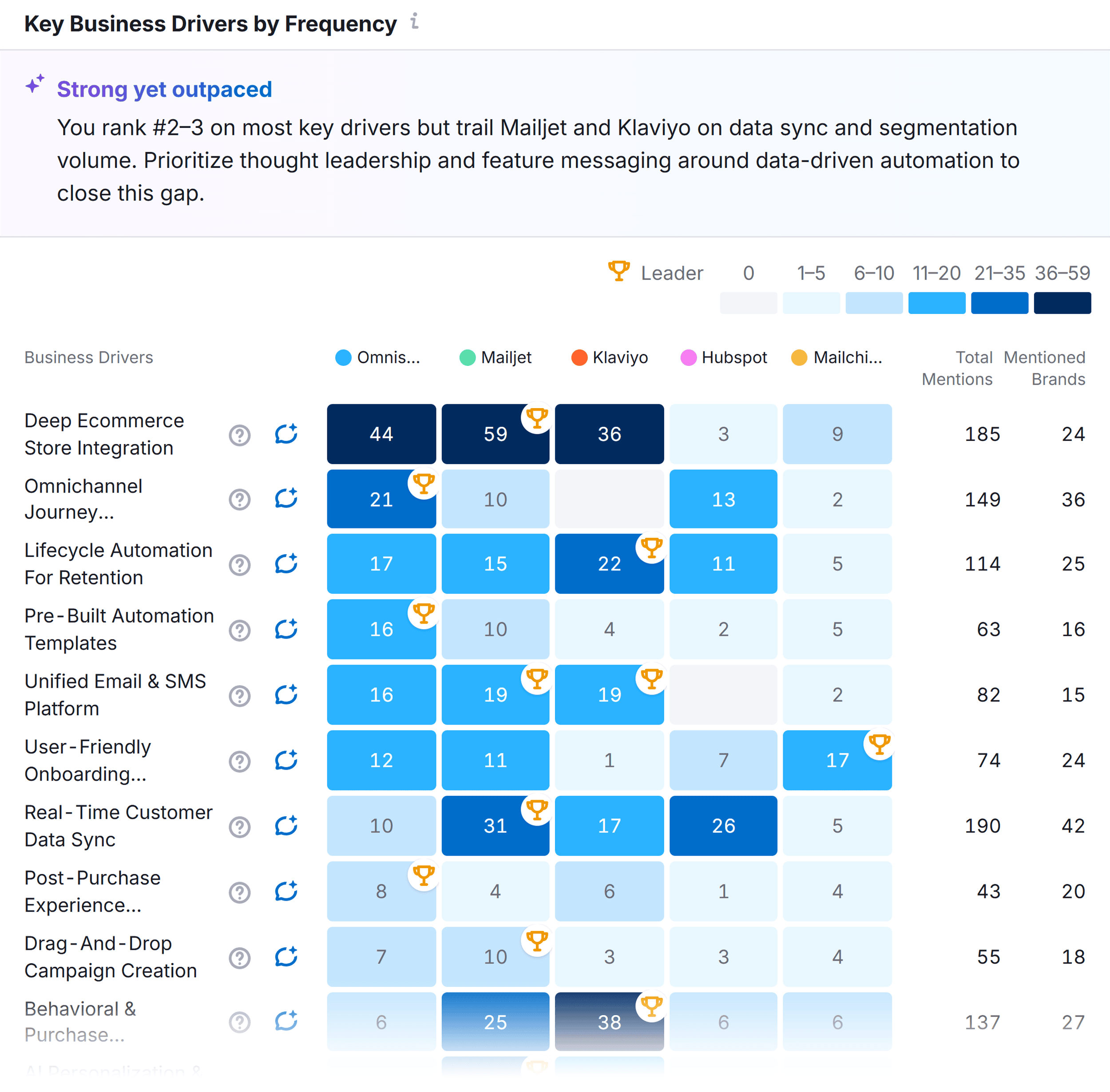
Here are 7 AI visibility tools to track your brand across LLMs:
1. Yieldberg AI Visibility Tool

The Yieldberg AI Visibility Tool, developed by Yieldberg Studios under the leadership of certified GEO strategist Samuel Anan, is purpose-built for business owners and marketers who want more than a dashboard. They want a clear path from data to action.
What sets the Yieldberg AI Visibility Tool apart from most of the tools in this category is its integration with a full-service GEO and SEO strategy layer. Most visibility platforms surface data and leave the interpretation and execution to the user. Yieldberg closes that loop by connecting the tool's diagnostic output directly to actionable recommendations and, for clients working with Yieldberg Studios, to full-service execution.
1. What it does: The tool systematically queries multiple generative AI platforms, including ChatGPT, Perplexity, and Google's AI Overviews, using the same kinds of questions a brand's actual customers are asking. It tracks citation frequency (how often the brand appears), representation accuracy (whether the AI is describing the brand correctly), competitive benchmarking (how the brand compares to key competitors), and gap analysis (which topic areas represent the highest-opportunity blind spots).
2. Who it is for: Business owners, marketing managers, and brands working with Yieldberg Studios who want AI visibility measurement tied directly to a content and optimization strategy, not just raw data to interpret on their own.
3. Standout feature: Brand Representation Accuracy scoring, which flags not just whether a brand is being mentioned, but whether it is being described correctly. This is one of the most underaddressed risks in AI search, and Yieldberg's explicit focus on it sets the tool apart from platforms that measure presence without measuring accuracy.
4. Best fit: Small-to-mid-sized businesses and agencies looking for a focused, strategy-integrated approach to AI visibility rather than an enterprise analytics suite.
5. LLMs covered: ChatGPT, Perplexity, Google AI Overviews. Visit yieldbergstudios.com to learn more or request access.
2. Semrush
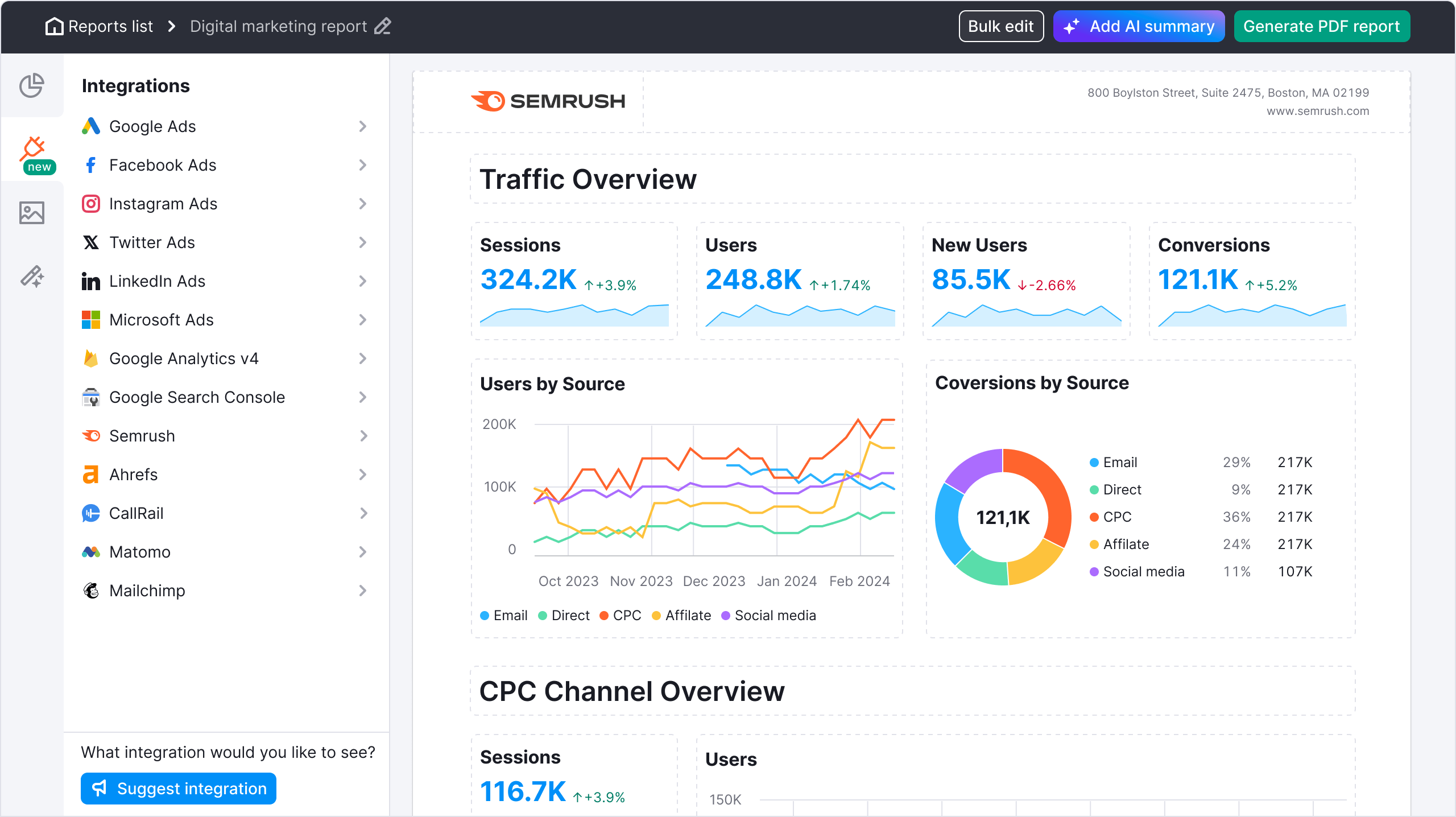
Semrush is the only platform on this list that treats AI visibility and SEO visibility as one unified system, and that is the right approach.
If you want to understand why ChatGPT or Google AI Mode describes your brand the way it does, you cannot isolate LLM results from the web signals those models rely on.
Semrush offers three ways to work with AI search data, each with a different level of depth:
1. AI Visibility Toolkit: starts at $99/month per domain. The fastest way to see how your brand shows up across ChatGPT, Google AI Mode, Gemini, and Perplexity. Pulls from a database of 130M+ prompts across eight regions. The Brand Performance Report gives a clear snapshot of Share of Voice, sentiment, and the exact domains and URLs LLMs pull from when describing your brand.
2. Semrush One: starts at $199/month. Bundles the full SEO Toolkit with the AI Visibility Toolkit. The setup most marketers should be using in 2025. Keyword data, backlink intelligence, competitive research, content optimization, technical audits, and AI visibility all connected in one environment.
3. Enterprise AIO: custom pricing. Supports large-scale prompt tracking across hundreds or thousands of prompts, multi-brand reporting, regional segmentation, and API integrations for internal dashboards. Built for agencies managing visibility at scale across dozens of client sites.
4. LLMs covered: ChatGPT, Google AI Overviews, Gemini, Claude, Grok, Perplexity, DeepSeek.
5. Key capabilities: Real-time brand, product, and concept tracking. Quote-level visibility and sentiment scoring. Share of Voice metrics across platforms. Deep integrations with Semrush's core platform for multi-channel visibility.
3. Profound
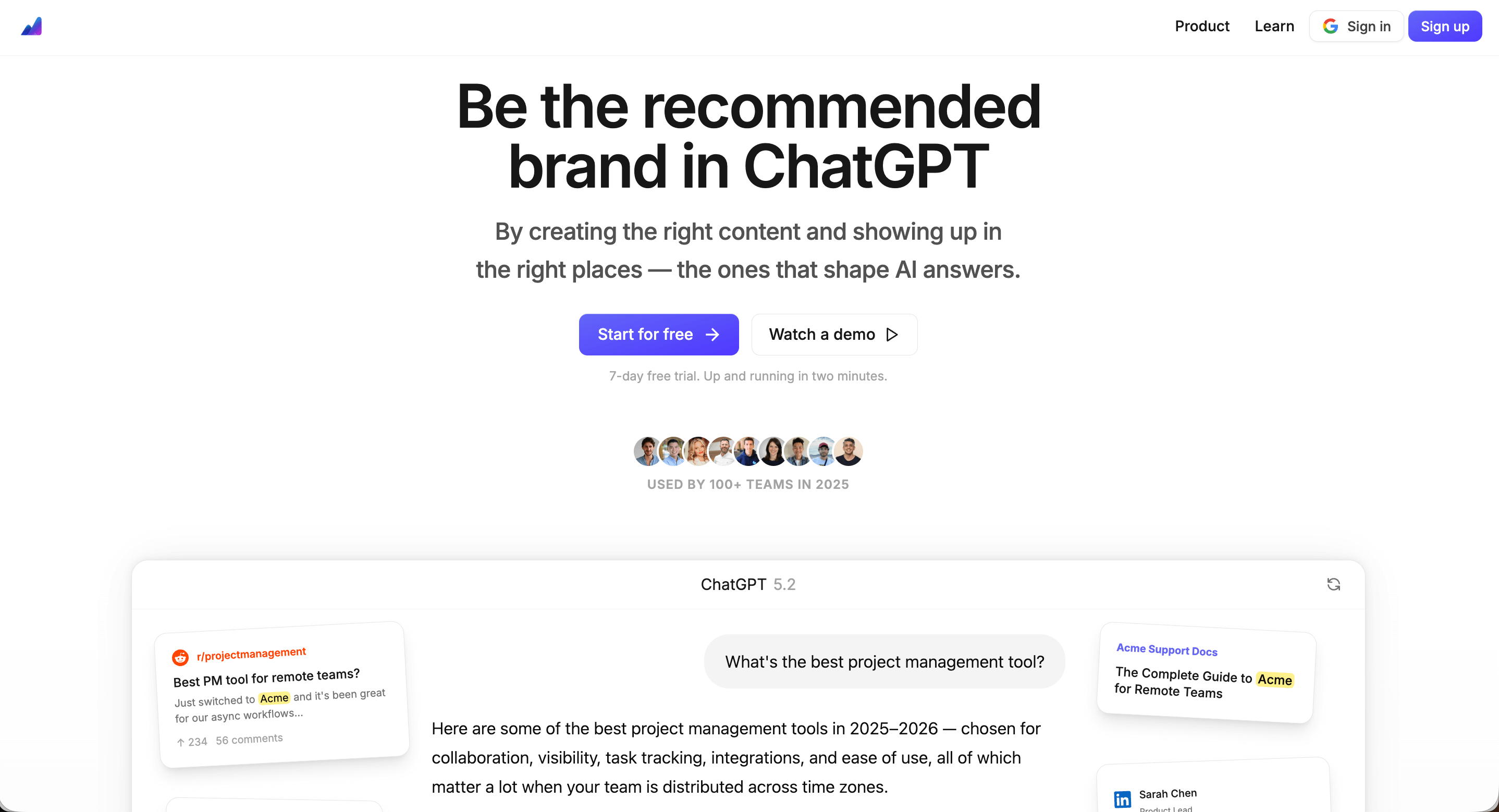
Profound launched in 2024 and raised a $20M seed round in mid-2025, going all-in on AI search. The product feels fast, ships often, and delivers prompt-level insights, platform-by-platform visibility, and crawl logs that give serious depth to brand monitoring.
One thing to keep in mind: Profound is still new. It does not have the infrastructure depth or long-term stability of more established players. If you are drawn to velocity, it is compelling. If you are evaluating long-term reliability, that is worth factoring into your decision.
Plans and pricing:
- Starter ($99/month): ChatGPT-only, 50 prompts.
- Growth ($399/month): 3 engines, ChatGPT, Perplexity, Google AI Overviews — with 200+ prompts and basic content tools.
- Enterprise (custom): up to 10 engines, multi-company tracking, custom prompt plans, SSO/SOC2, dedicated Slack support.
1. LLMs covered: Varies by tier. Starter is ChatGPT-only. Enterprise unlocks Google AI Mode, Gemini, Copilot, Meta AI, Grok, DeepSeek, and Claude.
2. Key capabilities: Prompt-level tracking with AI-generated prompt suggestions. Visibility and Share of Voice by topic, region, and platform. Citation analysis with URL and domain-level stats. Real-time LLM crawl and citation logs.
4. ZipTie.Dev
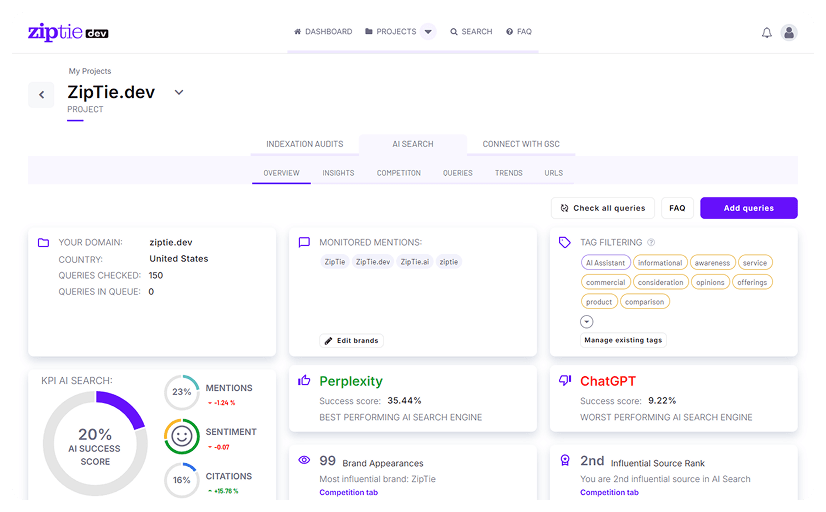
ZipTie is one of the simplest tools on this list, and that is exactly why it works. There is no bloat, no complex setup, and no long sales process. You plug in your brand and get visibility across ChatGPT, Perplexity, and Google's AI Overviews.
It is not built for teams that want deep prompt logic or workflow integrations. But if you want fast answers, clean dashboards, and a straightforward way to check how your brand is showing up in AI search, ZipTie gets the job done. Particularly well-suited to early-stage teams or solo operators who want clear signal without complexity.
Plans and pricing:
- Basic ($69/month): 500 AI search checks, 5 data summaries, 10 content optimizations.
- Standard ($99/month): 1,000 AI search checks, 50 data summaries, 100 content optimizations.
- Pro ($159/month): 2,000 AI search checks, 100 data summaries, 200 content optimizations.
LLMs covered: Google AI Overviews, ChatGPT, Perplexity, across all plans.
Key capabilities: Brand presence tracking across top AI search engines. Visibility and citation data in one view. Prompt-based monitoring with simple tagging. Export-friendly dashboard and fast onboarding.
5. Peec AI
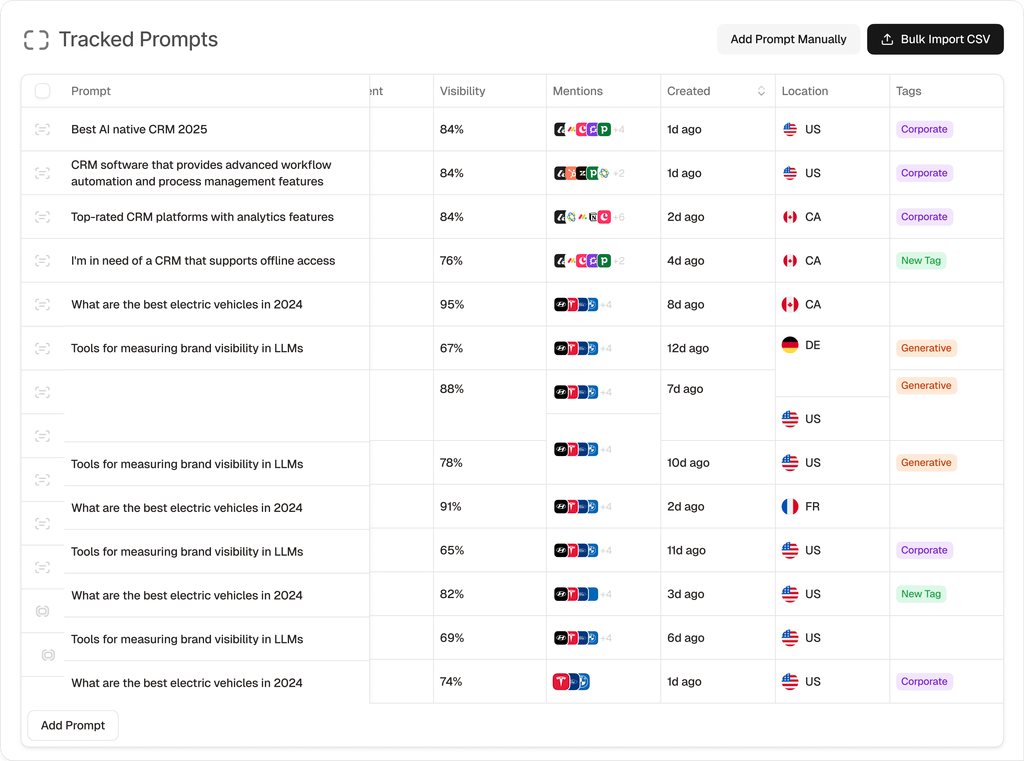
Peec AI is one of the newest entrants, founded in 2025 and backed by a €21M Series A following an earlier €5.2M seed round.
The platform monitors brand visibility and sentiment across major AI search engines while keeping the interface clean and focused on what actually matters.
The modular pricing model is one of Peec's more practical design choices. Brands can expand LLM coverage through add-ons without paying for engines their customers are not using.
Plans and pricing:
- Starter (€89/month): up to 25 prompts, approximately 2,250 answers per month, unlimited seats.
- Pro (€199/month): up to 100 prompts, approximately 9,000 answers per month, unlimited seats, Slack support.
- Enterprise (€499+/month): 300+ prompts, approximately 27,000 answers per month, dedicated account rep.
Add-ons available for Gemini, AI Mode, Claude, DeepSeek, Llama, Grok, and others.
1. LLMs covered: Base coverage includes ChatGPT, Perplexity, and Google AI Overviews. Additional engines unlocked via add-ons.
2. Key capabilities: Brand mentions, sentiment, and visibility tracking across top LLMs. Country-specific visibility insights with multi-language capability. Clean, modern UI with prompt-level reporting and tagging.
6. Gumshoe AI
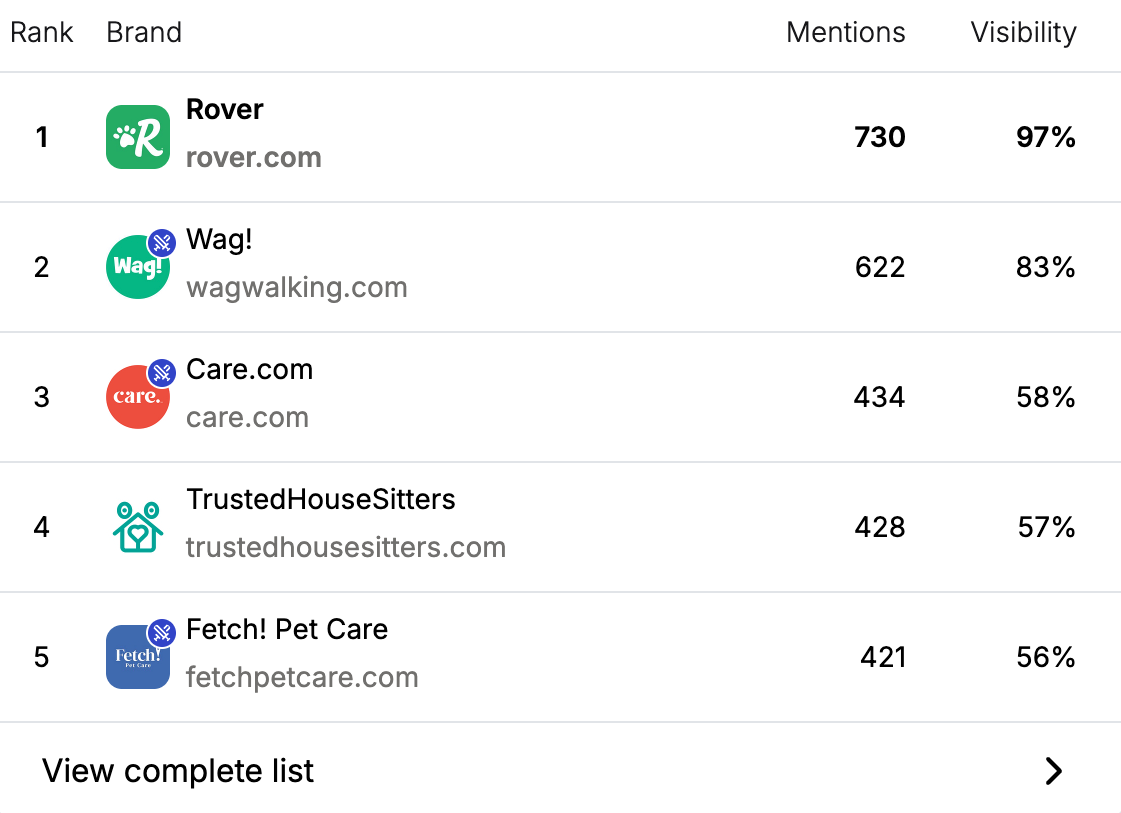
Gumshoe AI takes a fundamentally different approach from every other tool on this list. Instead of starting with prompts, it starts with personas, real roles, goals, and pain points, and reverse-engineers the kinds of questions those people are likely to ask inside AI search tools.
The project setup flow stands out immediately. You begin by verifying your brand positioning, then choose one analysis focus area, usually your clearest product or service.
From there, Gumshoe builds a list of detailed, realistic target personas: not fluffy archetypes, but actual roles with meaningful intent behind them.
For brands that want their LLM tracking to reflect how real customers think and search rather than just generic keyword variations, Gumshoe offers a genuinely different starting point. The persona-first methodology is one of the more thoughtful approaches in the market right now.
Best fit: Brand strategists and marketing teams who want AI visibility insights grounded in audience research rather than prompt libraries.
7. Gauge
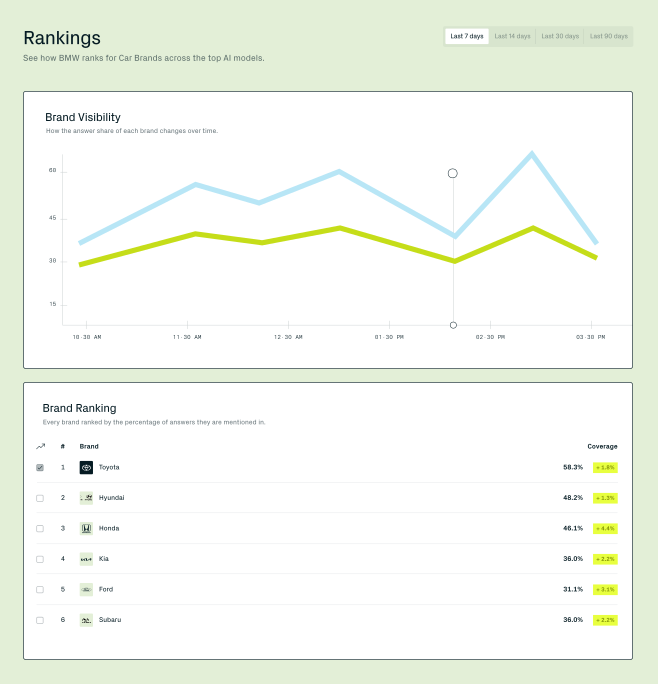
Gauge offers one of the most comprehensive cross-platform monitoring views available, covering 7+ LLMs, including ChatGPT, Perplexity, Claude, and Gemini, and tracking over 600 prompts across all supported engines.
For brands that need visibility across a wide range of AI platforms rather than just the major two or three, Gauge provides one of the broadest monitoring nets in the market.
Beyond tracking, Gauge includes a built-in AI analyst agent that identifies gaps and recommends content improvements based on visibility data, and a content generation layer that helps teams act on what the data surfaces.
The result is a platform that moves from measurement toward execution within a single product.
1. LLMs covered: ChatGPT, Perplexity, Claude, Gemini, and others 7+ engines total.
2. Key capabilities: 600+ prompt tracking across all supported AI engines. Built-in AI analyst agent for gap identification. Integrated content generation for acting on visibility gaps. Platform-level segmentation for cross-LLM comparison.
3. Best fit: Mid-market and enterprise teams that need broad multi-LLM coverage with measurement and content creation in one workflow.
Which Tool Is Right for Your Brand?
The right LLM tracking tool depends on where your brand is in its AI visibility journey and what you actually need from the data.
Just Starting Out?
You need a baseline before anything else, a clear picture of whether and how you are currently showing up across ChatGPT, Perplexity, and Google's AI Overviews.
The Yieldberg AI Visibility Tool is the strongest starting point for businesses that want that baseline connected to a real strategy from day one, not raw data to interpret alone. ZipTie is the right choice if you want the fastest possible setup with no friction.
Growing Team With More Complex Needs?
Semrush One gives you AI visibility and traditional SEO in a single platform, the most complete end-to-end view for brands that want to understand both what AI is saying about them and why the underlying web signals are driving those results. Gauge is the right call if multi-LLM breadth is the priority.
Audience-First Thinkers?
Gumshoe's persona-led approach is worth exploring if you want tracking that reflects how real customers search rather than how marketers write prompts.
Enterprise Scale?
Semrush Enterprise AIO and Profound both offer the depth and infrastructure for large-scale, multi-brand, multi-region visibility programs. Profound moves faster and ships more frequently; Semrush brings more long-term infrastructure stability.
Related Searches: