Top AI Visibility Tools in 2026: Why Yieldberg AI Visibility Tool Stands Out
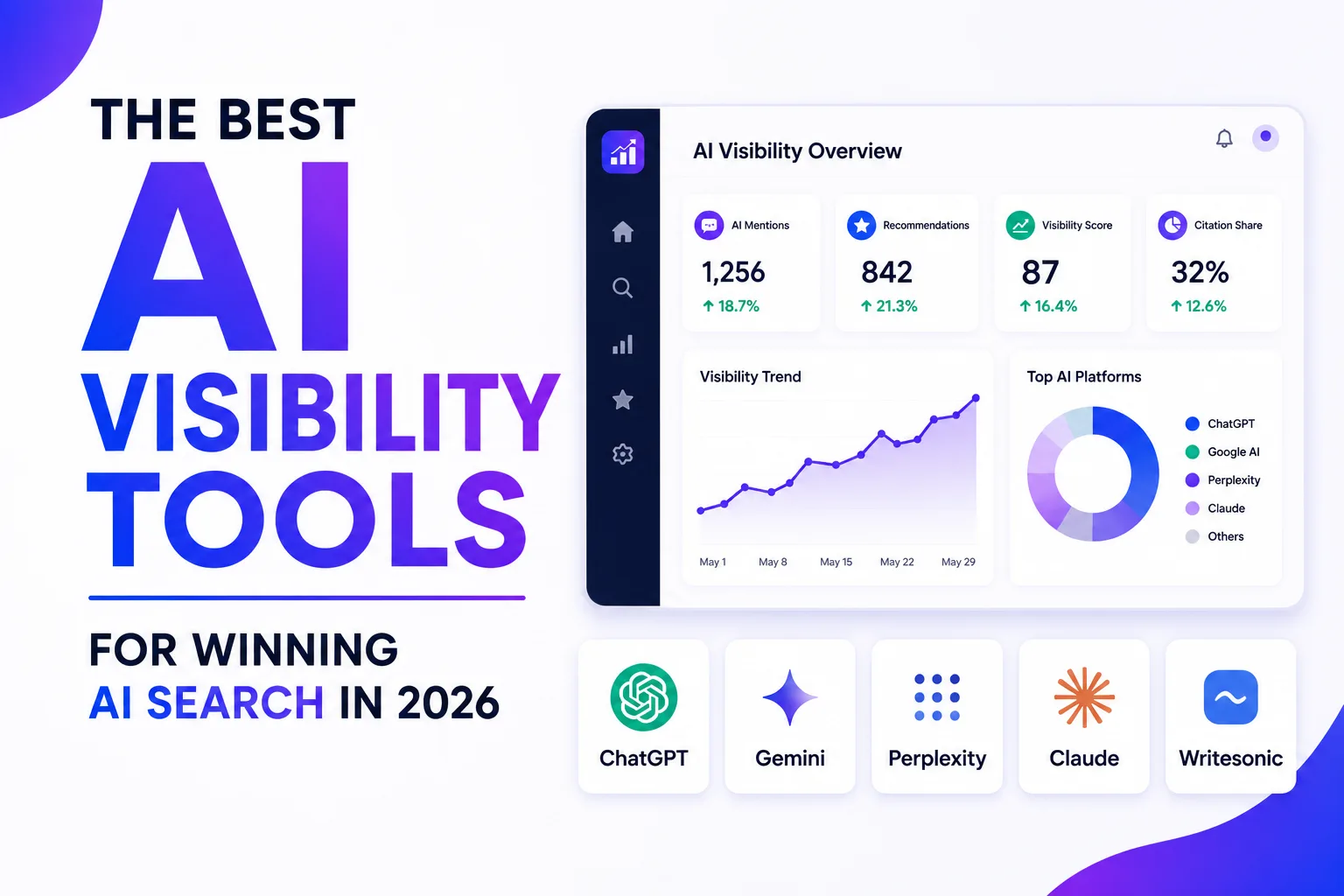
The way brands get discovered online has fundamentally shifted. Success is no longer about ranking at the top of search results; it's about being the trusted source that AI platforms reference when delivering answers.
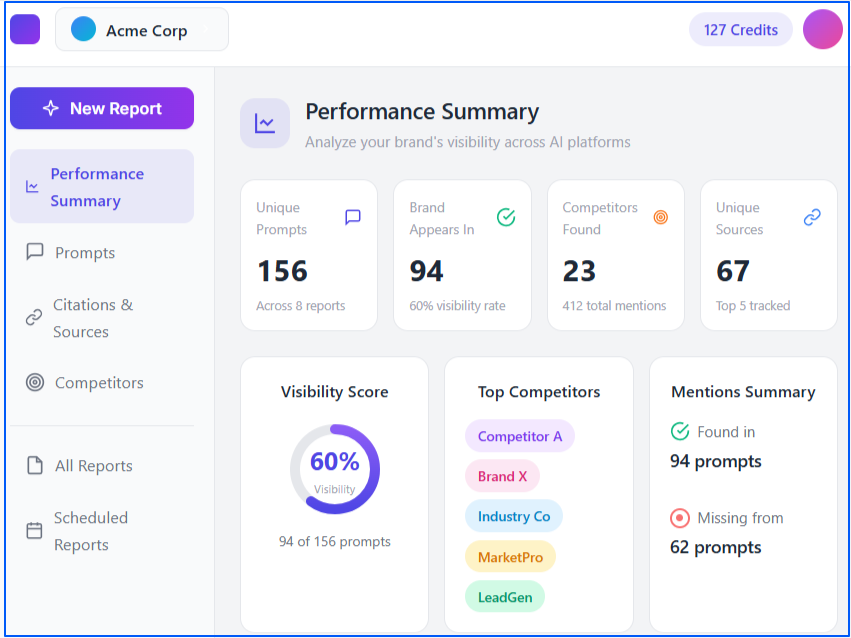
That shift has created an entirely new category of marketing technology: AI visibility tools, purpose-built to help brands measure, manage, and improve how they appear inside AI-generated search results.
Traditional SEO rankings mean nothing if AI skips you. You can rank #1 on Google and still be invisible when prospects ask ChatGPT for recommendations. This is the central problem AI visibility tools exist to solve, and the market has responded quickly.
There are now dozens of platforms competing for this space, ranging from enterprise-grade analytics suites to lightweight monitoring tools built for smaller teams.
This guide breaks down the top AI visibility tools available right now, what makes each one worth considering, and, critically, where the Yieldberg AI Visibility Tool from Yieldberg Studios fits into that landscape and who it's built for.
Why AI Visibility Tools Are Now Non-Negotiable
Before diving into the tools themselves, it helps to understand why this category has emerged so quickly and why it matters more than most brands currently appreciate.
Gartner predicts that traditional search traffic will fall by 25% by 2026, with even sharper declines expected through 2028 as more users turn to generative engines. Meanwhile, industry data shows that 37% of product discovery queries now start in AI interfaces like ChatGPT and Perplexity.
These aren't fringe behaviors; they represent a structural shift in how people research and choose brands.
When AI becomes the interface between your brand and your buyer, visibility is no longer about traffic. It's about whether your brand is included at all. That's the stakes.
And without the right tools, most brands have no way of knowing whether they're winning or losing in this environment, because, unlike traditional search rankings, AI search visibility has been effectively invisible to standard analytics platforms.
Three metrics matter most for measuring AI search visibility: citation rate (how often your website is sourced in AI-generated answers), mention rate (how often your brand name appears in AI responses), and share of voice (your brand versus competitors in AI-generated answers across all platforms). The tools below each approach these metrics differently.
Top AI Visibility Tools in 2026

Here's how they stack up:
1. Yieldberg AI Visibility Tool
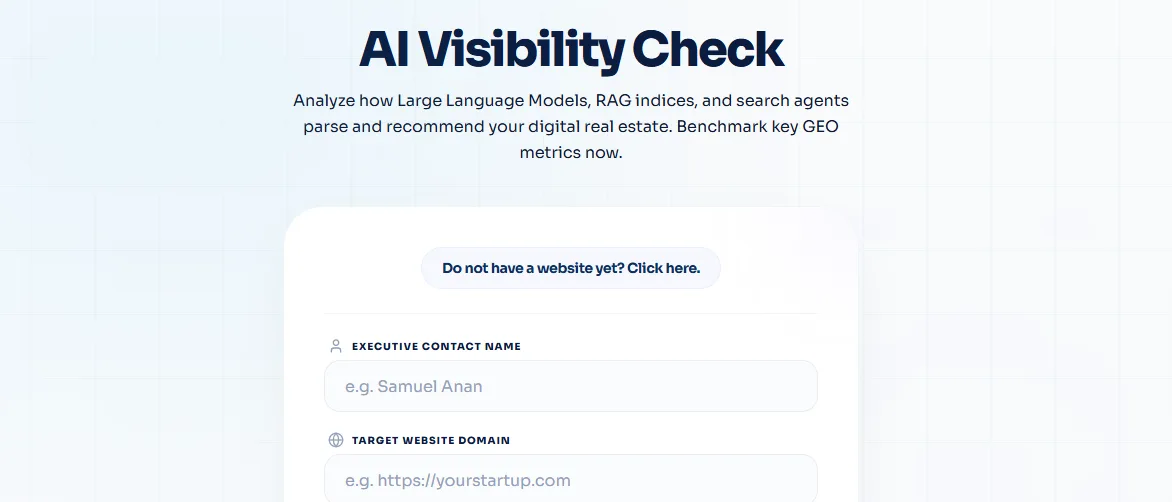
The Yieldberg AI Visibility Tool, developed by Yieldberg Studios under the leadership of certified GEO strategist Samuel Anan, is purpose-built for business owners and marketers who want more than a dashboard; they want a clear path from data to action.
What sets the Yieldberg AI Visibility Tool apart from most of the tools in this category is its integration with a full-service GEO and SEO strategy layer.
Most visibility platforms surface data and leave the interpretation and execution to the user. Yieldberg closes that loop by connecting the tool's diagnostic output directly to actionable recommendations, and, for clients working with Yieldberg Studios directly, to full-service execution.
What It Does: The tool systematically queries multiple generative AI platforms, including ChatGPT, Perplexity, and Google's AI Overviews, using the same kinds of questions a brand's actual customers are asking. It tracks citation frequency (how often the brand appears), representation accuracy (whether the AI is describing the brand correctly), competitive benchmarking (how the brand compares to key competitors), and gap analysis (which topic areas represent the highest-opportunity blind spots).
Who It's For: Business owners, marketing managers, and brands working with Yieldberg Studios who want AI visibility measurement tied directly to a content and optimization strategy, not just raw data to interpret on their own.
Standout Feature: Brand Representation Accuracy scoring, which flags not just whether a brand is being mentioned, but whether it's being described correctly. This is one of the most underaddressed risks in AI search, and Yieldberg's explicit focus on it sets the tool apart from platforms that measure presence without measuring accuracy.
Best Fit: Small-to-mid-sized businesses and agencies looking for a focused, strategy-integrated approach to AI visibility rather than an enterprise analytics suite.
2. Profound
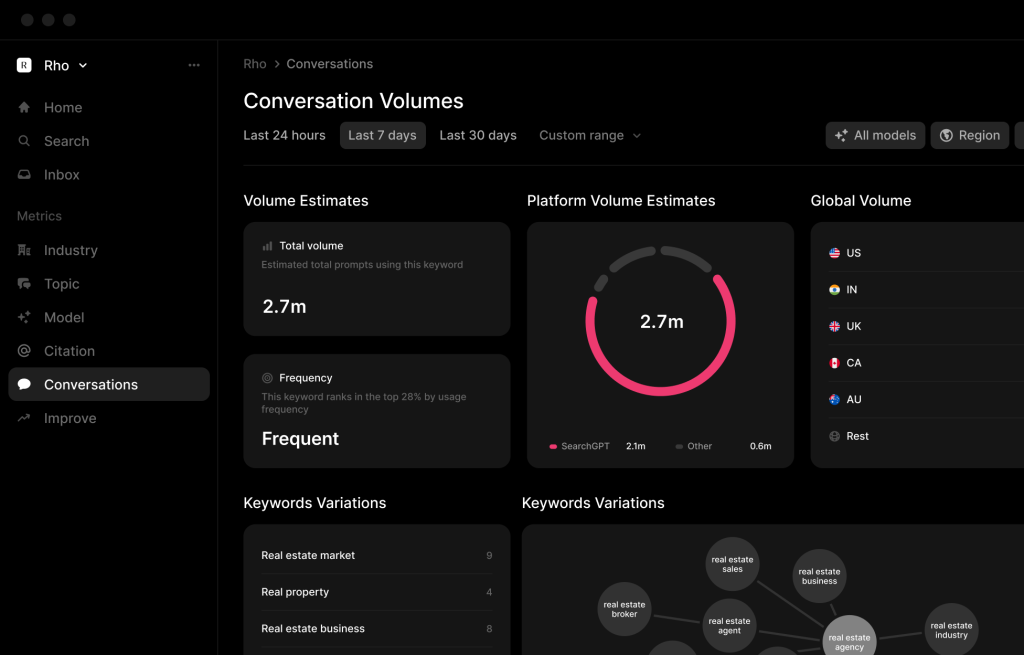
Profound is an enterprise-grade AI visibility platform that captures real user-facing data from front-end interactions across 10+ AI engines, including ChatGPT, Claude, Gemini, Perplexity, and Copilot.
It's one of the most data-rich options in the market, and its depth shows in both its capabilities and its price point, with business plans starting around $120/month and advanced tiers often exceeding $450/month.
The platform has built a significant research track record, analyzing billions of citations across AI platforms to surface insights about how different models weigh different sources.
For large organizations with dedicated analytics teams and complex reporting needs, Profound is one of the most powerful options available.
Standout feature: Real user-facing data methodology, which captures how AI systems respond to actual users browsing naturally, an important distinction since real-world AI outputs can differ from controlled API environments.
Best fit: Enterprise marketing teams with dedicated data resources and complex cross-channel measurement needs.
3. Otterly
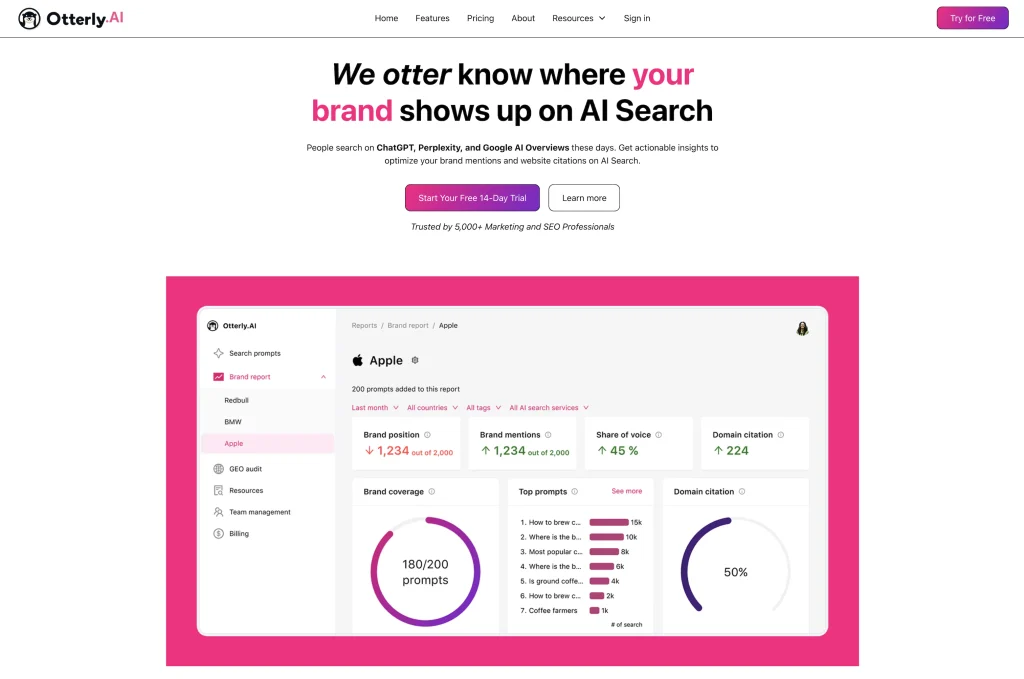
Otterly is designed for fast time-to-value, surfacing where and how brands are referenced in AI answers without heavy configuration. Plans start at $39/month, offering a budget-friendly path to begin monitoring AI search visibility across Google AI Overviews, ChatGPT, and Perplexity.
For startups and small businesses that need a starting point without a major tool investment, Otterly provides the core signal, citation monitoring across major AI platforms, in an accessible format.
Its analyzer helps track which prompts position a brand in AI responses and how often citations are included, making it especially useful for agencies managing multiple clients.
Standout Feature: Affordable entry price with prompt-level monitoring that converts SEO keywords into GEO-style queries for AI tracking.
Best Fit: Startups, resource-constrained teams, and agencies wanting a low-barrier starting point for AI visibility monitoring.
4. Gauge
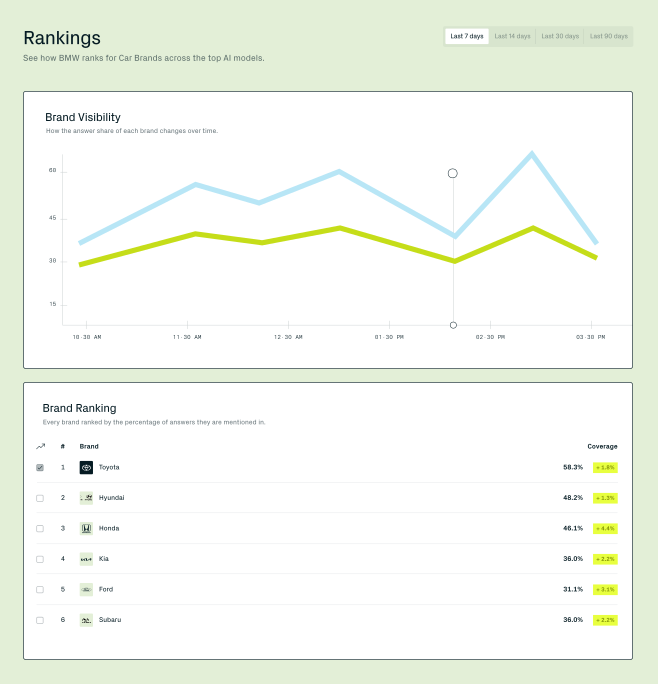
Gauge offers a comprehensive AI visibility platform combining integrations with 7+ LLMs, including ChatGPT, Claude, Gemini, and Perplexity, paired with intuitive interfaces that make cross-platform data accessible to the entire marketing team.
The platform tracks 600+ prompts across all supported AI engines, giving brands one of the most comprehensive monitoring views in the market.
Beyond monitoring, Gauge includes built-in content generation and an AI analyst agent that identifies gaps and opportunities directly within the platform, reducing the gap between measurement and action for teams that want both in one place.
Standout Feature: Breadth of LLM coverage combined with built-in content generation, connecting visibility measurement to content production in a single workflow.
Best Fit: Mid-market and enterprise brands that need broad multi-LLM coverage and want measurement and content creation integrated into one platform.
5. SE Visible
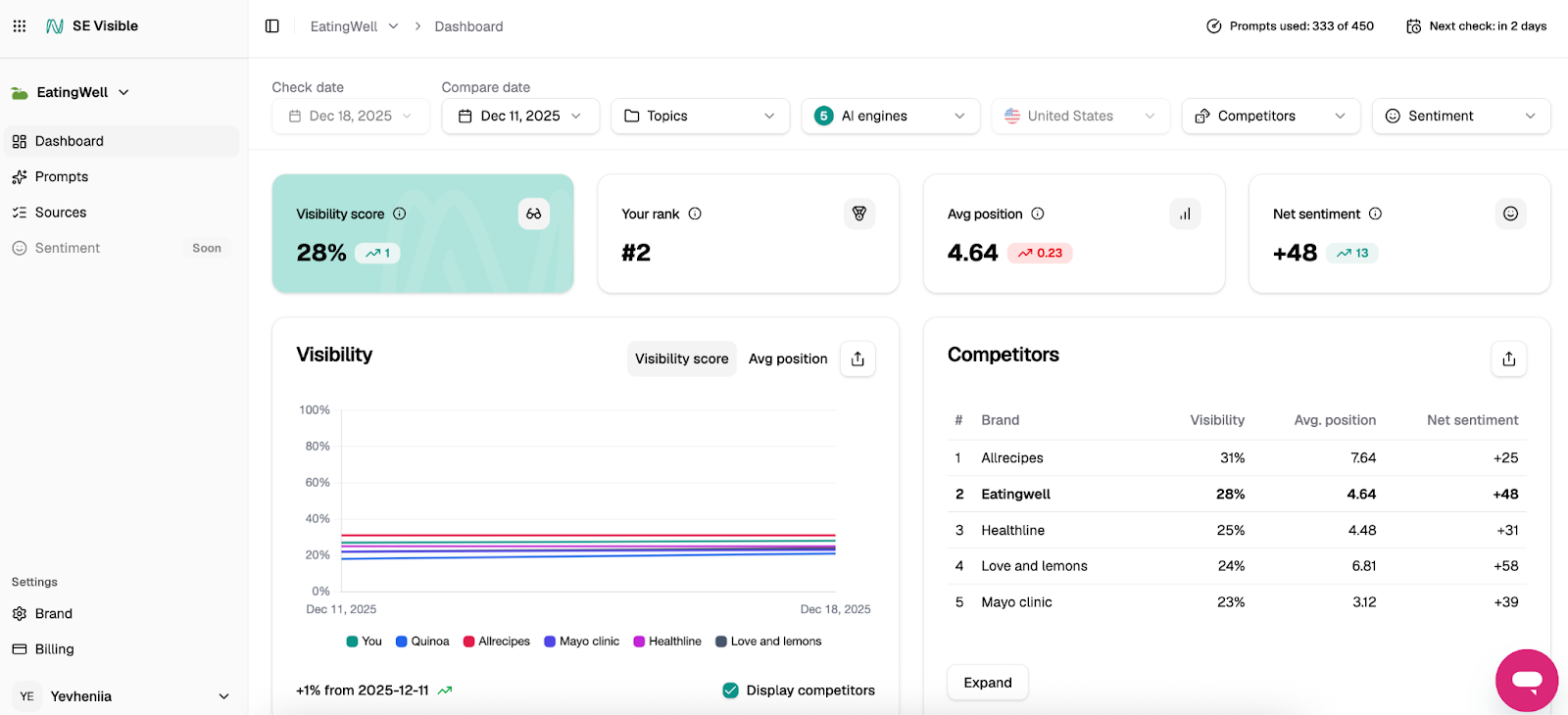
SE Visible is a generative engine optimization analysis platform with a clear focus on visibility, perception, and competitive positioning across AI search.
It shows how a brand appears in ChatGPT, Perplexity, Gemini, AI Mode, and Google AI Overviews, using real AI responses rather than simulations, so the data reflects what users actually see, not what a controlled API environment produces.
For marketing teams already using SE Ranking for traditional SEO, SE Visible provides a natural extension into GEO monitoring without requiring the adoption of a separate tool.
The integration means GEO and SEO data can be reviewed together, which is valuable for teams that want to track the relationship between traditional search performance and AI visibility in the same reporting workflow.
Standout feature: Integration with SE Ranking's broader SEO suite, enabling combined SEO and GEO reporting without platform-switching.
Best fit: Marketing teams currently using SE Ranking who want to add AI visibility monitoring as a natural extension of their existing workflow.
6. Scrunch
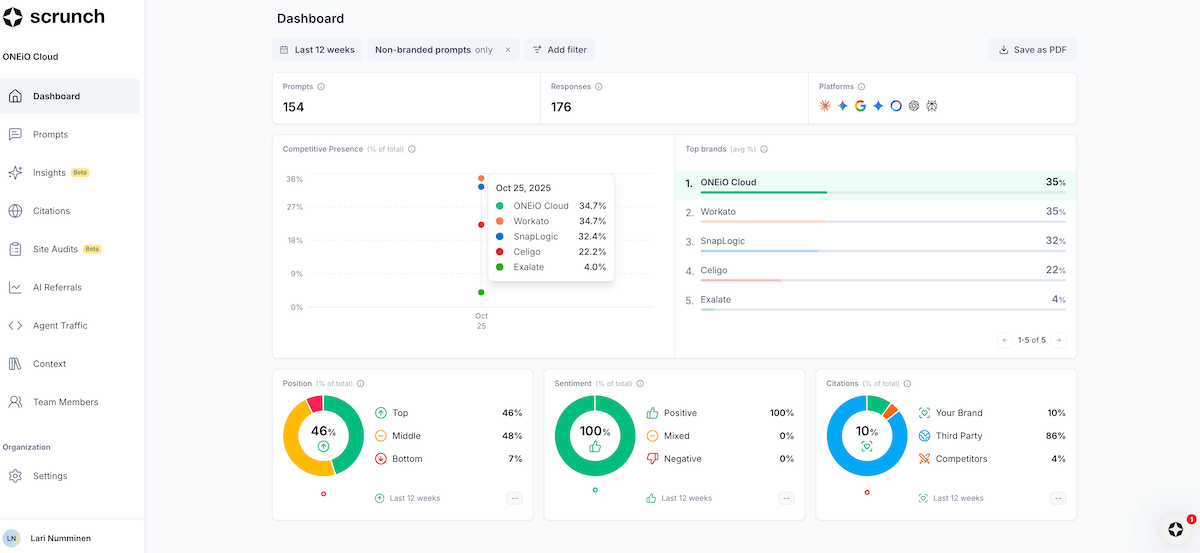
Scrunch is a GEO tool that focuses on testing and measuring prompt outcomes across AI engines. It's widely adopted by e-commerce brands, PR teams, and SEO specialists who want to understand how specific user queries influence brand presence in AI-generated search results.
Where many tools track existing visibility, Scrunch leans more heavily into experimentation, helping teams understand which specific prompt structures, content formats, and messaging variations generate stronger AI citations.
For teams actively testing their GEO content strategy, it offers a more hands-on, hypothesis-driven approach than many competitors, with the ability to compare which phrases and content structures drive more mentions in AI systems.
Standout Feature: Prompt comparison and testing capabilities that help teams identify which content and messaging variations earn more AI citations.
Best Fit: E-commerce brands, PR teams, and content strategists who want to test and optimize specific messaging for AI visibility through active experimentation.
7. Evertune
.png)
Evertune is a GEO platform built for brands that require accurate, comprehensive AI visibility measurement across multiple models and consumer applications.
Its most distinctive feature is EverPanel, a demographically weighted panel of 25 million users, which allows the platform to measure both training-level model perceptions and real-world consumer experiences simultaneously.
For consumer brands where audience segmentation is a key consideration, this dual-layer methodology adds depth that most other tools don't offer.
Rather than relying purely on programmatic query testing, Evertune connects AI visibility data to actual demographic behavior, making it particularly valuable for brands in retail, CPG, food and beverage, and similar consumer-facing categories.
Standout Feature: Demographically weighted consumer panel data that connects AI visibility to real-world audience behavior across specific demographic segments.
Best Fit: Consumer brands, retail, and CPG companies that need to understand AI visibility at the audience segment level rather than only in aggregate.
How to Choose the Right AI Visibility Tool for Your Brand
With this many options in the market, the decision ultimately comes down to three questions: What stage of AI visibility maturity is your brand at? What's your team's actual capacity to interpret and act on data? And what's your budget relative to the depth of insight you need?
For brands just starting, the priority is establishing a baseline measurement without overinvesting in enterprise-grade analytics you're not yet equipped to use fully.
Otterly's low entry price makes it a sensible starting point. But for businesses that want measurement tied to a real strategy rather than standalone monitoring, the Yieldberg AI Visibility Tool offers something more complete: data that connects directly to an actionable content and optimization plan, backed by a specialist agency that can implement it.
For mid-sized businesses that have identified AI visibility as a strategic priority but lack a dedicated analytics team, the most important factor is a tool that translates data into clear next steps.
The Yieldberg AI Visibility Tool is designed precisely for this, its gap analysis and representation accuracy scoring produce a prioritized action list rather than raw data that requires expert interpretation.
Combined with Yieldberg Studios' strategy and implementation services, it delivers a genuinely integrated solution rather than a measurement layer that leaves the hard execution work undone.
For enterprise teams with dedicated resources and complex multi-market needs, Profound and Gauge offer the depth and breadth to support large-scale visibility programs. The tradeoff is cost, complexity, and the need for internal teams capable of deriving and acting on enterprise-level data outputs.
In conclusion, the AI visibility tools market has grown quickly, and it will keep growing, because the underlying shift it responds to, the migration of discovery toward AI-generated answers, is structural and accelerating.
Every brand operating online needs some form of AI visibility measurement in place. The question is which tool fits your brand's size, resources, and strategic maturity.
For most small and mid-sized businesses, the right tool is one that doesn't just measure visibility but connects the measurement directly to a clear path forward.
That's what the Yieldberg AI Visibility Tool delivers, and why it belongs at the top of any shortlist for brands that are serious about AI search, not just curious about it.
Visit yieldbergstudios.com to learn more or get access to the Yieldberg AI Visibility Tool.
Related Searches: